


Intelligent autonomous vehicles must be capable of perceiving their surroundings to make timely decisions and ensure safe driving. For short-range applications such as parking and blind spot detection, ultrasonic technology is highly favored for its simplicity and robustness. Recently, ultrasonic technology has opened up many new use cases due to its versatility. This blog will briefly introduce the development history of ultrasonic sensors and, by combining current and future applications, predict the application areas of ultrasonic sensors in the coming years.
A Brief History of Automotive Ultrasonic Sensors
Ultrasonic technology is commonly used for detecting objects and identifying defects in solid materials, with its first patent dating back to the 1930s. Traditionally, ultrasonic technology has been used in detection applications, such as intruder alarm systems. As vehicles became equipped with more electronic devices, automakers began seeking solutions to prevent damage during driving. Early solutions involved installing ultrasonic sensors in bumpers and pairing them with in-car buzzers to alert drivers of potential hazards. Later, a screen was added to the buzzer system to display the location of obstacles.
With advancements in ultrasonic transducers, performance has improved, primarily through enhanced signal-to-noise ratio (SNR) and increased detection range. These improvements have enabled sensing technology to be used in more safety-critical automotive applications, such as detecting other vehicles in blind spots or assessing road conditions to adjust braking on wet surfaces.
Recently, ultrasonic sensors have started being used inside vehicle cabins to detect passengers, triggering seatbelt warnings and ensuring airbags are deployed based on the size and weight of the passenger, in response to anticipated regulations. They can also monitor driver alertness and detect breathing and heart rates.
Considering the complexity of modern dashboards, gesture control is likely to become increasingly popular. In such applications, ultrasonic sensors track the driver’s hand movements and use them as input signals to operate the vehicle, similar to pressing a switch or turning a knob.
onsemi’s Ultrasonic Sensor Solutions
Since 2007, onsemi has been a market leader in providing ultrasonic sensor interfaces for parking assistance and autonomous driving to major automotive OEMs. When combined with piezoelectric ultrasonic transducers and some additional circuitry, onsemi’s NCV75215 ultrasonic sensor offers time-of-flight (ToF)-based distance measurement.
The advantage of this system lies in its ability to identify obstacles during parking or low-speed short-range maneuvers. When the circuitry and transducer allow, this highly sensitive device can detect standard 75mm poles within a range of 0.25 meters to 4.5 meters.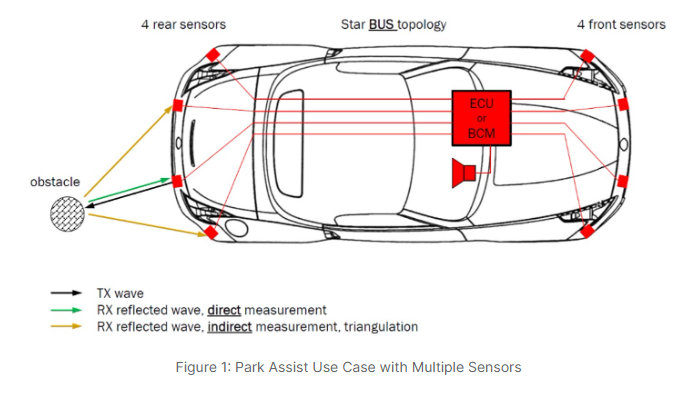
For a comprehensive evaluation of the chip’s performance in parking (or similar) applications, designers can request the NCV75215R1GEVK ultrasonic parking assistance kit from onsemi. This evaluation kit, based on an advanced graphical user interface (GUI), is easy to operate and allows for thorough evaluation and detailed debugging of prototypes. The evaluation kit (EVK) includes an EEPROM for storing critical user data and configuration settings. The chip supports full access and allows key parameters such as receive (Rx) gain and transmit (Tx) current to be adjusted via the GUI.
Future Trends and Innovations
For example, in 4D sensing, micro-electromechanical systems (MEMS) microphones are placed alongside ultrasonic sensors. MEMS microphones can receive ultrasonic signals and detect other sounds, including noise from approaching vehicles. An important use case is identifying emergency vehicle sirens, prompting appropriate actions.
Challenges include the accumulation of dust and moisture, which can degrade the performance of ultrasonic sensors and front-facing cameras. Recent innovative designs have incorporated piezoelectric devices into sensor components, enabling high-frequency vibrations. This has proven effective in removing raindrops, general dirt, and ice buildup, ensuring the proper functioning of safety-critical sensors.
Environmental concerns are driving the industry toward electric propulsion, making it crucial to understand the state of charge (SoC) and state of health (SoH) of traction batteries. While this is typically achieved through voltage and current measurements, this method has limitations. Ultrasonic transducers installed inside the battery can provide highly accurate indications of the battery’s SoC and SoH.
Recently, this trend has expanded into in-vehicle applications and industrial applications (such as autonomous robots and automated guided vehicles) to further enhance safety. Innovation in the automotive sector continues to accelerate, advancing toward higher levels of ADAS and autonomous driving. In the future, ultrasonic technology is expected to deliver higher performance and expand its applications in industrial domains.