


The automotive industry is undergoing a profound transformation, with meeting functional safety requirements and adhering to Software-Defined Vehicle (SDV) standards becoming a shared consensus across the sector. This shift not only changes the way Original Equipment Manufacturers (OEMs) design and manufacture vehicles but also provides new perspectives for driving the industry's transition toward intelligence and connectivity. Recently, Qing Zhang, Automotive Marketing Manager at onsemi, elaborated on onsemi's innovative automotive headlight driver solutions and value propositions under the SDV trend during the 33rd DVN Lighting Workshop.
Software-Defined Vehicles: How Does the Zonal Architecture Define New Value Points?
Traditional vehicle architectures, based on centralized electronic control units and complex wiring, inherently limit scalability and performance. The Zonal architecture, however, reorganizes and modularizes the vehicle's electronic systems by physical location, dividing them into specialized modular zones. This improves overall system coordination and response speed, meeting the data exchange demands of modern vehicles with numerous sensors and actuators. It also enhances scalability, interoperability, and system compatibility, while posing higher requirements for SDVs.
A notable change is that the data architecture, as a critical component of the vehicle's electrical architecture, involves the exchange and management of internal vehicle data. As vehicle functionalities increase, the volume of data grows exponentially, requiring communication architectures capable of handling more data. Moreover, optimizing automotive communication architectures through zonal controllers, gateways, and software update frameworks is crucial for improving safety performance and system management efficiency. Automotive Ethernet, with its high bandwidth, scalability, and security, has become the preferred solution for SDVs.
For OEMs, the core objectives of developing SDVs are to enhance flexibility and upgradability, reduce costs, and improve efficiency. Through software updates, OEMs can continuously improve vehicle functionalities and add new features without hardware modifications. Additionally, simplifying design processes reduces complexity and costs, accelerates product development cycles, and improves market responsiveness. SDVs also open new revenue streams for OEMs, such as on-demand features and subscription-based services, extending the profitability lifecycle of vehicles and enhancing user experiences by combining digital services with advanced safety features for a more personalized driving experience.
Based on 10Base-T1S, onsemi Introduces MCU-less Automotive Headlight Solution
Taking automotive LED headlights as an example, traditional headlights typically require an MCU to control various LED driver modules. To align with the evolution of SDV trends, onsemi has innovatively introduced an MCU-less headlight solution, utilizing a 10Base-T1S Ethernet interface to gradually replace traditional CAN or LIN network structures. This enables zonal control through an ECU-Light architecture, achieving Ethernet connectivity at each node.
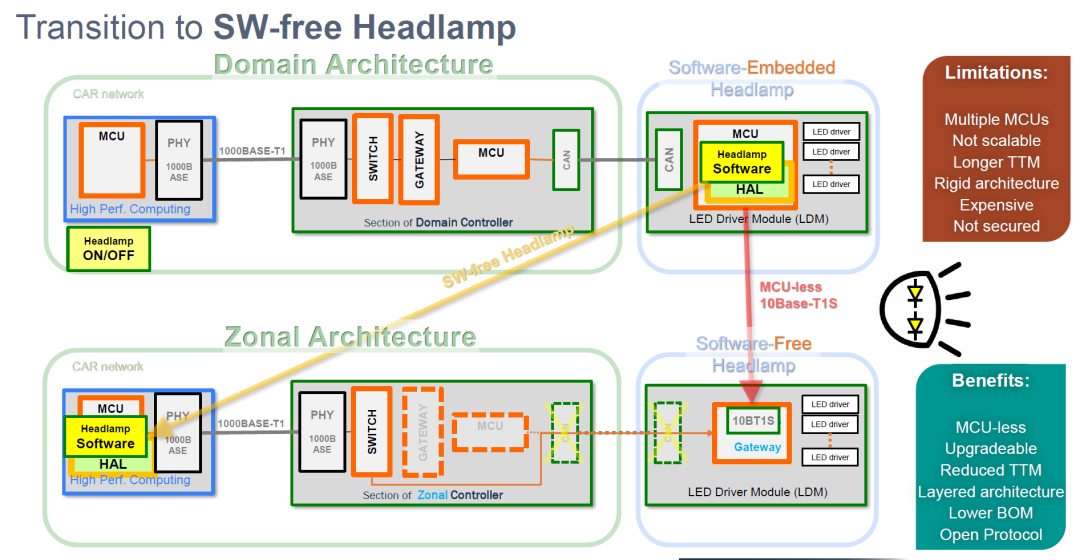
By integrating control logic into the RCP chip, this solution eliminates the need for an MCU. This design not only simplifies system architecture and reduces costs but also makes software updates more convenient and facilitates functional expansion. Data exchange occurs at the software layer, including control, reporting, and user interface/application programming interfaces (APIs). This data exchange not only enhances performance but also enables vehicles to better adapt to new technologies and market demands.
Additionally, this solution features a highly integrated design, offering the smallest size and lowest BOM cost in the market. These drivers support single-chip boost and buck channels, integrate current sensors, and eliminate the need for additional shunt resistors, optimizing cost, size, and efficiency.
It is worth emphasizing that onsemi's latest Treo platform, built on advanced 65nm BCD process technology, enables rapid implementation of this automotive LED driver solution. The Treo platform supports a wide voltage range of 1-90V and operating temperatures up to 175°C. Its modular architecture allows for the quick integration of various analog and digital IPs from onsemi, significantly accelerating the development of new products while greatly reducing costs.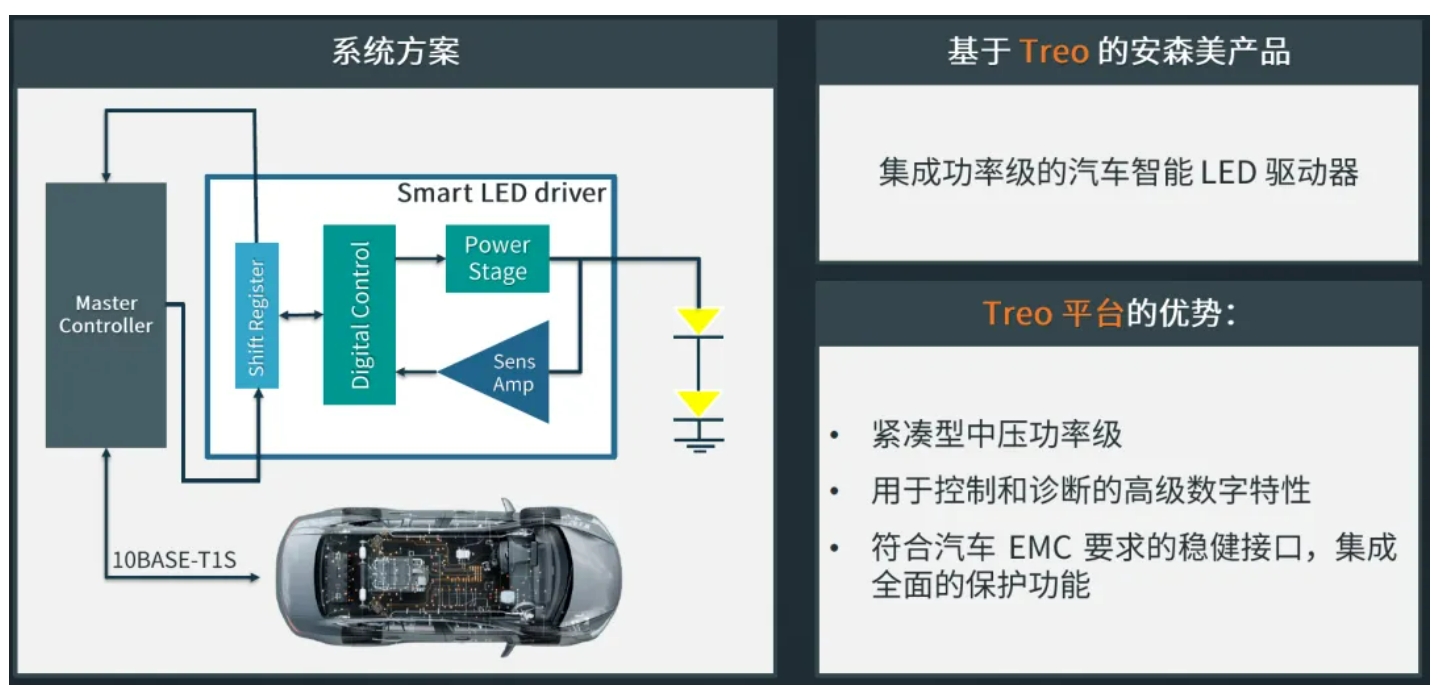
Software-Defined Vehicles offer OEMs faster innovation, lower costs, and new business models, gradually becoming a new industry consensus. With over 15 years of experience, onsemi has demonstrated exceptional performance and integration in automotive bus control and LED driver solutions, helping OEMs and lighting manufacturers enhance user value, support Software-Defined Vehicles, and drive the future development of intelligent transportation.