


Since the Lexus LS 600h first introduced LED light sources for low beam headlights, LED technology has rapidly advanced in the industry due to its advantages such as high brightness, long lifespan, stable performance, and energy efficiency. Today, LED headlights have become standard equipment for mid- to high-end vehicle trims and are quickly penetrating into mid- to low-end trims as well. As cars become safer and smarter, LED headlights are also evolving, taking on more and more functions, such as ADB (Adaptive Driving Beam), AFS (Adaptive Front-lighting System), or integrating various sensors as part of autonomous driving systems. We can foresee that LED headlights will continue to develop rapidly and find even broader applications.
The LED headlight system is a highly electrified module that requires the use of numerous connectors internally. Depending on the application location of the connectors, they can be categorized into two types: LED driver (controller) connectors and LED light board connectors. During the evolution of LED headlights, new requirements and challenges have been introduced for the connectors used internally. These requirements are mainly reflected in the following two aspects: First, the number of pins in LED driver (controller) connectors has been increasing, primarily influenced by the trend of added functionality and integration. Second, the size of the connectors has become increasingly smaller. The design of LED headlights has become more diverse, and in recent years, the shapes of headlights have become increasingly "sharp," resulting in very limited internal space within the headlights.
Molex focuses on industry trends and leverages its successful collaboration experience with numerous OEMs and Tier One suppliers to introduce connectors such as DuraClik, Mini50, stAK50h, and the MX150 Rotatable series, designed for LED headlamp systems to address various challenges and issues encountered in LED headlamp design.
The designs of daytime running lights and turn signals vary greatly, but the space inside the lamp cover is limited. The design of car headlights reflects the brand identity of the automobile, and the diverse shapes of headlights impose different requirements on their internal circuits. The internal circuits of LED headlight systems can be divided into two categories: the driver (control) circuit and the lamp board circuit. As for the lamp board circuit: • The car lights are flat, compressing the internal space, and the connector size must be small. • Daytime running lights are mostly three-dimensional curves, requiring multiple PCBs or FPCs to be combined. The height of the connector should be as low as possible. • Connectors are required to link the light panels, with the number of positions ranging from 2 to 8. • Sequential turn signals require individual control of each LED bead, with a range of 6 to 15 units. • Improve PCB utilization and welding production efficiency |
|
Industry trends and customer needs
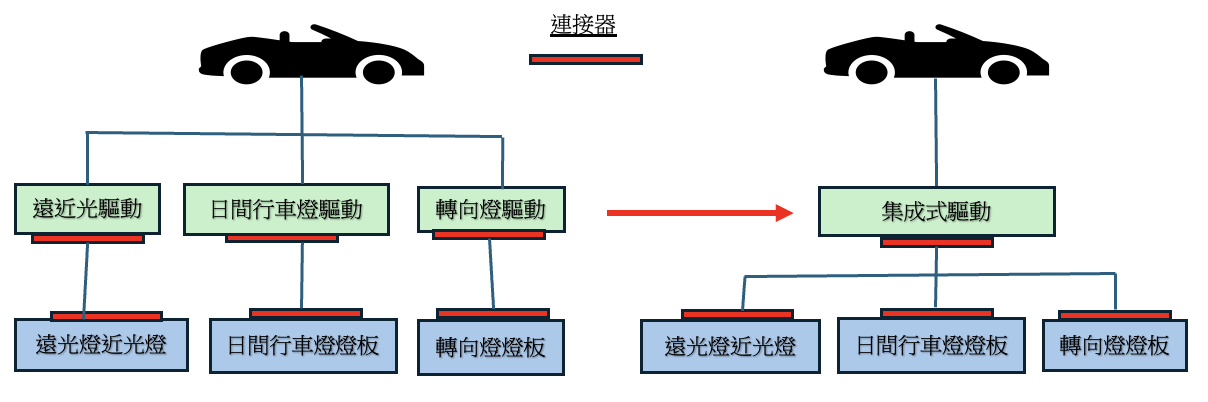
Integration of driver (controller) functions, increased current for miniaturized connectors, and an increase in the number of pins.
The number of pins required for connectors inside car lights is increasing, especially for driving or control circuits, and it is expected to exceed 30 pins.
• ADB/AFS lights ADAS functionality penetration
• Matrix-style headlight system, motor-controlled
• With increased power, connectors need to have greater current-carrying capacity.
Driver integration can save internal space and reduce the number of components in LED headlights, thereby lowering module costs, reducing failure rates, and shortening the development cycle.
Provide continuous and reliable connectivity
Inside the car lamp, the working environment of the connector is quite complex:
• Vehicle vibration, thermal shock, high temperature, and high humidity
• LED heat dissipation and operating temperature rating must be at least 105°.
• Sufficient mechanical strength
Therefore, the connectors must undergo rigorous testing to ensure they can still provide reliable electrical connections under various environments and operating conditions.
Driver and light panel connector solution
DuraClick daytime running light and turn signal connector daytime running light and turn signal connector
Smaller size • Lower height, Duraclik features a single-row pin design with an overall height of only 6.4mm. • Narrower width, 2.0mm pitch, embedded soldering legs further reduce the width | SMT soldering • Does not occupy backplane space, enhancing the PCB. Utilization rate • Wave soldering process to enhance welding efficiency | The product specifications are complete. • Targeted product specifications, no waste Each PIN • 2 to 15 needles, with products available for each digit. |
Driver (controller) connector, Mini50 & stAK50h. Mini50 & stAK50h feature compact size, high pin count, and high current capacity.
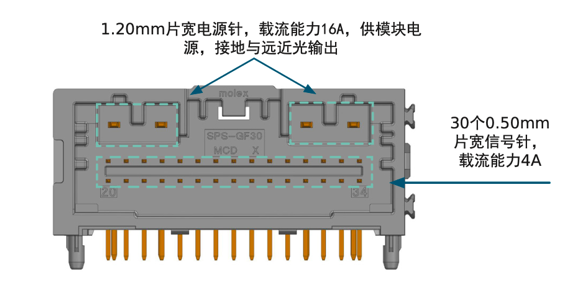
Integrated Controller Solution 1 Mini50 34-position hybrid connector (Part Number 349610340)
• The industry's smallest 0.50mm terminal system, reducing connector size • Hybrid pin design, with 4 high-current pins providing greater support for power and grounding. Load capacity • The product supports through-hole reflow soldering, reducing process costs.
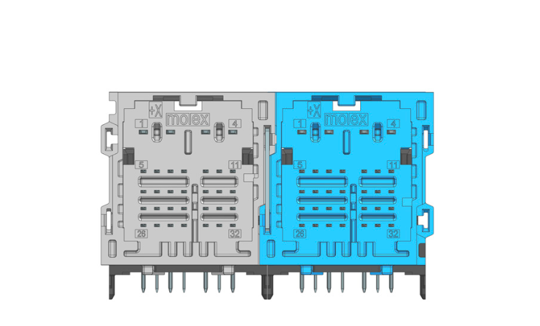
| Integrated Controller Solution 2 StAK50 hybrid pin connector
• 0.50mm terminal system with mixed pin design combined with 1.20mm terminal system • 5-row terminal layout, efficiently utilizing vertical space with up to 64 pins, saving PCB area while providing more PINs. • The product supports through-hole reflow soldering, reducing process costs.
|
|
|
Automotive-grade connectors, widely used in LED headlights.
• Mini50 was developed based on USCAR-2, while stAK50h was developed based on GWM3191, and both have passed rigorous mechanical, electrical, and environmental testing.
• The Duraclik ISL version has passed LV214 certification and is temperature resistant up to 125°.
• Both Mini50 and Duraclik feature secondary terminal locks to enhance terminal retention.
• Soldering pins enhance the connector's retention force
LED headlight assembly external interface connector
For LED headlight assemblies, apart from the non-sealed connections used on the light board and controller. In addition to the components, a sealed connector is also required as the external interface for the headlight assembly, because... The headlamp assembly is installed in the wet area of the vehicle, so it needs to achieve an IPX7 or even IPX9K sealing rating. Level.
|
|
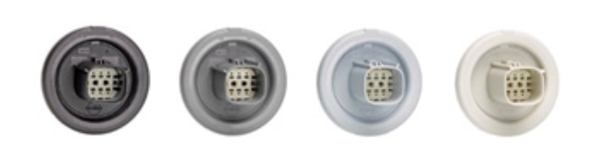
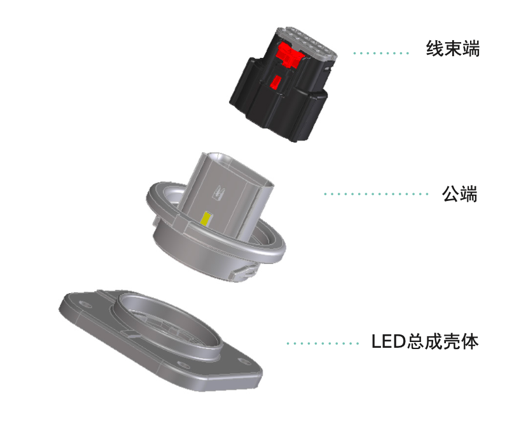
Convenient headlight assembly installation The headlamp assembly housing is typically an injection-molded component, and the external interface connector needs to be sealed properly with the headlamp assembly housing using an appropriate method. The MX150 rotary installation version is a product specifically developed for headlamp application scenarios, and its rotary installation offers the following advantages: • The connector is installed from the outside in, ensuring that the sealing ring of the connector is completely covered by the plastic housing. This prevents accidental damage to the sealing ring and eliminates any slots that could potentially accumulate water. • The rotary installation is simple to operate and does not require assembling additional components such as screws or clips, ensuring the assembly efficiency of the connector. • The rotary snap-fit design prevents stress relaxation in the clips, providing a more reliable connection. Additionally, the female connector features a self-waterproof design, with a built-in sealing gasket. This eliminates the need for the wiring harness manufacturer to crimp sealing plugs, thereby improving wiring harness production efficiency. |
|
Excellent sealing performance
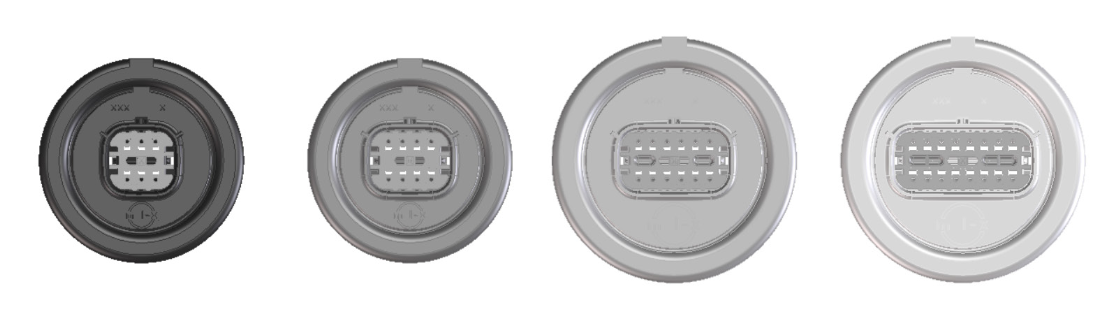
Sealing performance is a critical performance indicator for the external interface connectors of automotive lighting assemblies. The MX150 adopts Molex's mature and stable sealing structure design, with product performance validated according to the GMW3191 standard. This ensures that the connector can still meet sealing performance requirements after undergoing environmental tests such as high temperature and humidity, thermal shock, and long-term aging. The sealing level has reached the highest grade, S3, in the standard, capable of handling extreme sealing demands such as high-pressure water spray. | Product part number 6 Confucius: 34840-3410 8 Confucius: 34840-4410 12 Confucius: 34840-6410 16 Confucius: 34840-8410 |
Product Information
Mini50 connector
Board Serial Number | Wire harness end serial number | Number of terminal blocks | Board-end direction | Pin type | Digit |
34792 | 206523 | Single row | Vertical | Perforation | 4, 8 |
34793 | 2, 4, 8 | ||||
34912 | Horizontal | Surface Mount Technology | |||
34825 | 34824 | Duo queue | Vertical | Perforation | 12, 16, 20, 24 |
34826 | |||||
215422 | Horizontal | Surface Mount Technology | |||
34897 | |||||
34958 | 34959 | Three rows | Vertical | Perforation | 34, 38 |
213355 | Horizontal | ||||
34961 |
Performance parameters |
|
|
|
Terminal plating | Tin | Operating voltage | 14 volts |
Contact resistance (maximum) | 20 milliohms | Operating temperature | -40 to 105°C |
Current-carrying capacity | 4.0 amps | Vibration level | USCAR-2 V1 |
Crimping wire diameter | 0.13 to 0.35 millimeters2 | Insulation resistance (minimum) | 100 megaohms |
DuraClik Connector
Board serial number | Harness end serial number ISL | Board-end direction | Pin type | Digit |
502352 | 560123 | Horizontal | Surface Mount Technology | 2 ~ 15 |
560020 | Vertical |
Performance parameters | |||
Terminal plating | Tin | Operating voltage | 125 volts |
Contact resistance (maximum) | 20 milliohms | Operating temperature | -40 to 130°C |
Current-carrying capacity | 4.0 amps | Vibration level | LV214 |
Crimping wire diameter | 0.22 to 0.35 millimeters2 | Insulation resistance (minimum) | 100 megaohms |
stAK50h connector*
Connector Pin Count | 0.50mm pin pitch | 1.20mm pin count | 2.80mm pin count | 6.3mm pin count | Board-end connector part number | Wire harness terminal connector part number | |
Vertical | Horizontal | ||||||
12 | - | 8 | 4 |
| 160026 | ||
23 | 21 | - | - | 2 | 300229 | ||
25 | 21 | - | 4 |
| 160027 | ||
27 | 19 | 8 | - |
| 160029 | ||
28 | 21 | 7 | - |
| 160014 | ||
32 | 28 | 4 |
|
| 160028 | ||
Performance parameters | |||
Terminal plating | Tin | Operating voltage | 14 volts |
Contact resistance (maximum) | 20 milliohms | Operating temperature | -40 to 105°C |
Current-carrying capacity | 0.50mm / 4.0A, 1.2mm / 7.8A, 2.8mm / 16.0A, 6.3mm / 17.0A | Vibration level | GWM3191 V1 |
Crimping wire diameter | 0.13 to 6.00 millimeters2 | Insulation resistance (minimum) | 100 megaohms |
The stAK50h series products can be freely spliced on the board side, and multiple board sides can be assembled into a connector assembly to create different pin configurations. Enter 'stAK50h' on the Molex official website to find the optimal splicing combination.
MX150 Dual-Row Twist-Lock Fixed Connector
Board serial number | Harness end serial number | Board edge direction | Pin type | Digit |
34840 | 33472 | Perforated type | Crimp wire to wire | 6, 8, 12, 16 |
Performance parameters | |||
Terminal plating | Tin | Operating voltage | 14 volts |
Contact resistance (maximum) | 8 milliohms | Operating temperature | -40 to 105°C |
Current-carrying capacity | 17A | Vibration level | GMW3191 |
Crimping Diameter | 0.35 ~ 1.5 millimeters2 | Insulation resistance (minimum) | 100 megaohms |