


The ‘optical’ (light) in optical semiconductor devices
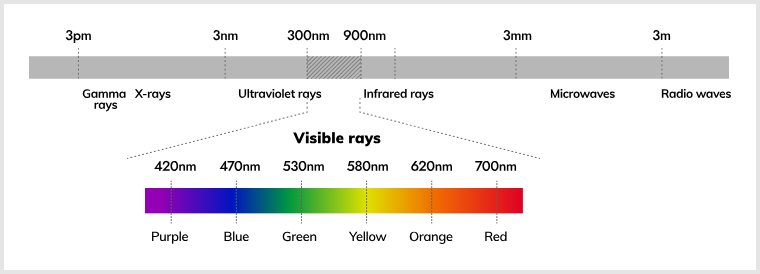
Let’s first consider light, a crucial element of optical semiconductor devices. Like the radio waves used in TVs and smartphones, or the X-rays utilized in medical settings, light is a type of electromagnetic wave. The difference between light and radio waves lies in their wavelengths. Please refer to the following diagram for details.
The ‘semiconductor’ in optical semiconductor devices
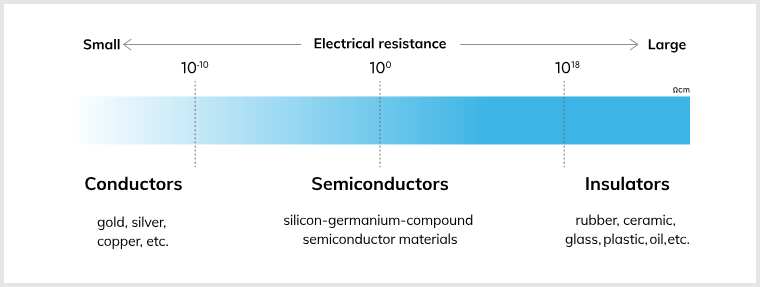
Next, let’s discuss another key element of optical semiconductor devices: the semiconductor. Semiconductors have properties that place them between conductors, which conduct electricity, and insulators, which do not conduct electricity. Conductors include metals such as gold, silver, copper, and iron, while insulators comprise materials like rubber, glass, ceramics, plastics, and oil.
On the other hand, semiconductors include silicon and germanium, as well as compound semiconductor materials such as gallium arsenide, gallium phosphide, gallium nitride, and indium phosphide. Among these, silicon is the most widely used, serving as the material for transistors and integrated circuits (ICs) that underpin modern society.
The ‘device’ in optical semiconductor devices
The term ‘device’ refers to equipment that is used for a specific purpose. In the case of optical semiconductor devices, their primary function is to convert electricity into light or vice versa. This conversion feature is incorporated into intricately-structured elements. These elements can convert electric current into light or, conversely, light into electric current. The existence of such devices has significantly transformed our lives, giving rise to many convenient technologies, including the following:
An optical semiconductor (light-emitting element) that converts electric current into light
LED | Lighting, traffic lights, displays, backlights for electronic devices, etc. |
Laser diodes | Writing of DVDs, optical fiber communication, 3D sensors, etc. |
Infrared LED | TV remote controls, security cameras, vehicle cameras, etc. |
Optical semiconductors (light-receiving element) that convert light into electric current
Photodiodes | Camera exposure meters, optical communication systems, spectroscopes, night vision devices, etc. |
Phototransistors | Used for a wide range of applications including automatic doors, cameras, smartphones, photoelectric sensors, etc. |
What are optical semiconductors?
So, what exactly are optical semiconductors? As the name implies, optical semiconductors combine the characteristics of light and semiconductors. Specifically, they can be divided into two types: light-emitting elements and semiconductor lasers that convert electric current into light, and light-receiving elements that convert light into electric current. The wavelength of the photoelectric conversion varies depending on the material of the optical semiconductor.
Semiconductors can consist of a single element like silicon (Si) or germanium (Ge), but those made up of multiple elements are called compound semiconductors. Due to their unique properties, compound semiconductors are used in a variety of applications.
Deep UV | AlGaN / GaN on Sapphire |
Violet, Blue | InGaN / GaN on Sapphire |
Green | GaP on GaP |
Yellow | AlInGaP on GaAs |
Red | GaAlAs on GaAs |
Infrared | GaAlAs on GaAs |
Near infrared | InGaAs on InP (for Photo-detector) InGaAsP on InP (for LED) |
Features and uses of compound semiconductors
Single-element semiconductors like silicon and germanium have low luminous efficiency and are primarily used as photo-detectors. Conversely, compound semiconductors have high luminous efficiency and are used in light emitting diodes (LEDs) and semiconductor lasers. Additionally, due to their capability for high-speed operations, they are also employed in high-speed photodiodes for optical communications.
Combination of compound semiconductors as seen from the periodic table
| Ⅱ | Ⅲ | Ⅳ | Ⅴ | Ⅵ |
|---|---|---|---|---|
| B | C | N | ||
| AI | Si | P | ||
| Zn | Ga | Ge | As | Se |
| Cd | In | Sn | Sb | Te |
The expansion of optical semiconductor technology
Optical semiconductor technology significantly impacts various aspects of our lives. For example, TV and air conditioner remote controls use infrared rays to transmit and receive information. Additionally, optical media like CDs and DVDs utilize light to write and read stored information.
Furthermore, the evolution of optical semiconductor devices is evident in the field of lighting. As is well known, traditional incandescent and fluorescent lights are increasingly being replaced by LEDs. Combining high luminous efficiency and longevity, LEDs offer energy efficiency and cost-effectiveness. This shift to LEDs has also spread to areas like flashlights and car headlights. Additionally, the progression to LED-based traffic signals enhances their visibility while reducing energy consumption. These LEDs are also a type of optical semiconductor device.
Thus, the evolution and widespread adoption of optical semiconductor devices are making our lives more convenient and sustainable. For more details on the features and applications of the technologies used in optical semiconductor devices, please contact Dexerials.