


Protection technology for enhancing battery safety
Since their introduction in 1991, lithium-ion batteries have quickly become the standard battery for mobile devices due to their high voltage and low self-discharge rate. To enhance their safety, we developed the Self-Control Protector (SCP) as a secondary protection component to prevent overcharging and overcurrent. Over the years, the Self-Control Protector (SCP) has played a critical role in the evolution of safety measures for lithium-ion batteries. This article provides an overview of lithium-ion batteries and explores the role and development of the Self-Control Protector (SCP) in improving battery safety.
What is a lithium-ion battery?
Lithium-ion batteries are a type of rechargeable battery that have now become standard in portable electronic devices. Unlike traditional nickel-cadmium batteries, lithium-ion batteries can be recharged by reversing the chemical reaction. This rechargeable capability makes them ideal for devices that require repeated use, such as smartphones, laptops, and electric vehicles. The key components of lithium-ion batteries include the cathode, anode, electrolyte, and separator, which work together to store and release energy. These characteristics have led to the widespread adoption of lithium-ion batteries across various industries.
Comparison between lithium batteries and lithium-ion batteries
Although lithium batteries and lithium-ion batteries both use lithium as a key component, there are significant differences between them. Lithium batteries are typically single-use (non-rechargeable) batteries, whereas lithium-ion batteries are rechargeable. Lithium batteries generally have higher energy density and longer storage life, but their application is limited due to their single-use nature. On the other hand, lithium-ion batteries can be recharged hundreds of times, making them more suitable for devices that require frequent charging and discharging.
The difference between primary batteries and secondary batteries
Disposable batteries are designed for single use and must be discarded once depleted. In contrast, rechargeable batteries can be recharged and used multiple times, making them more cost-effective and environmentally friendly in the long run. The primary advantage of rechargeable batteries lies in their reusability, which is especially important for applications requiring long-term continuous power supply, such as laptops, smartphones, and electric vehicles.
For more information on the reuse and recycling of lithium-ion batteries, please refer to this article.Towards a Sustainable Society: Recycling and Reusing Lithium-Ion Batteries and Dexerials' Protective Devices – TECH TIMES | A Technical Information Media for Engineers
What is a secondary lithium battery?
Secondary lithium batteries refer to rechargeable lithium-based batteries, such as lithium-ion batteries and lithium polymer batteries (LiPo). These batteries can be repeatedly charged and used. Secondary lithium batteries are characterized by high energy density and long lifespan, and are widely used in various fields ranging from consumer electronics to electric vehicles.
The operating principle of lithium-ion batteries
Lithium-ion batteries work by moving lithium ions between the anode and cathode through an electrolyte. During discharge, lithium ions flow from the anode to the cathode, providing energy to the connected device. When charging, an external power source returns the lithium ions to the anode, storing energy for later use. This reversible chemical process allows the battery to be recharged multiple times. With the advancement of this cutting-edge technology, efforts are being made to further improve safety measures.
A product with a long history
Because the electrolyte in lithium-ion batteries contains flammable organic solvents, overcharging can pose a risk of fire or explosion. For this reason, the lithium-ion battery cells and charge-discharge circuits currently available on the market are always equipped with a control function called 'primary protection' to prevent issues that could lead to accidents, such as overcurrent or overcharging.
However, even the most advanced electronic circuits can fail in extremely rare circumstances. In the early 1990s, Sony Chemicals Corporation (now Dexerials Corporation) was commissioned to develop a secondary protection component for lithium-ion batteries in case the primary protection failed.

Working principle of battery protection circuit
The battery protection circuit is an essential component that safeguards lithium-ion batteries from potential hazards such as overcharging, over-discharging, and short circuits. These circuits monitor the battery's voltage and temperature to ensure it operates within a safe range. If any parameter exceeds its threshold, the protection circuit intervenes by disconnecting the battery from the load or charger to prevent damage.
The function of the lithium-ion battery protection circuit
Lithium-ion battery protection circuits are specifically designed to protect lithium-ion batteries. They are typically composed of electronic components such as transistors, diodes, and resistors, which work together to regulate current flow. The circuit is also equipped with a monitoring system that continuously checks the battery's status and triggers protective measures when necessary. These circuits are essential for extending the lifespan of lithium-ion batteries and ensuring their safe operation in various applications.
Understanding these protective measures is crucial for ensuring the reliability of battery-powered devices in various applications, including those utilizing condensation sensor technology.
Condensation sensor technology
The development of SCP began with the condensation sensor in video cameras. Initially, Sony Chemicals aimed to develop a sensor similar to a PTC thermistor using condensation sensor technology. However, due to various challenges, this approach did not succeed.
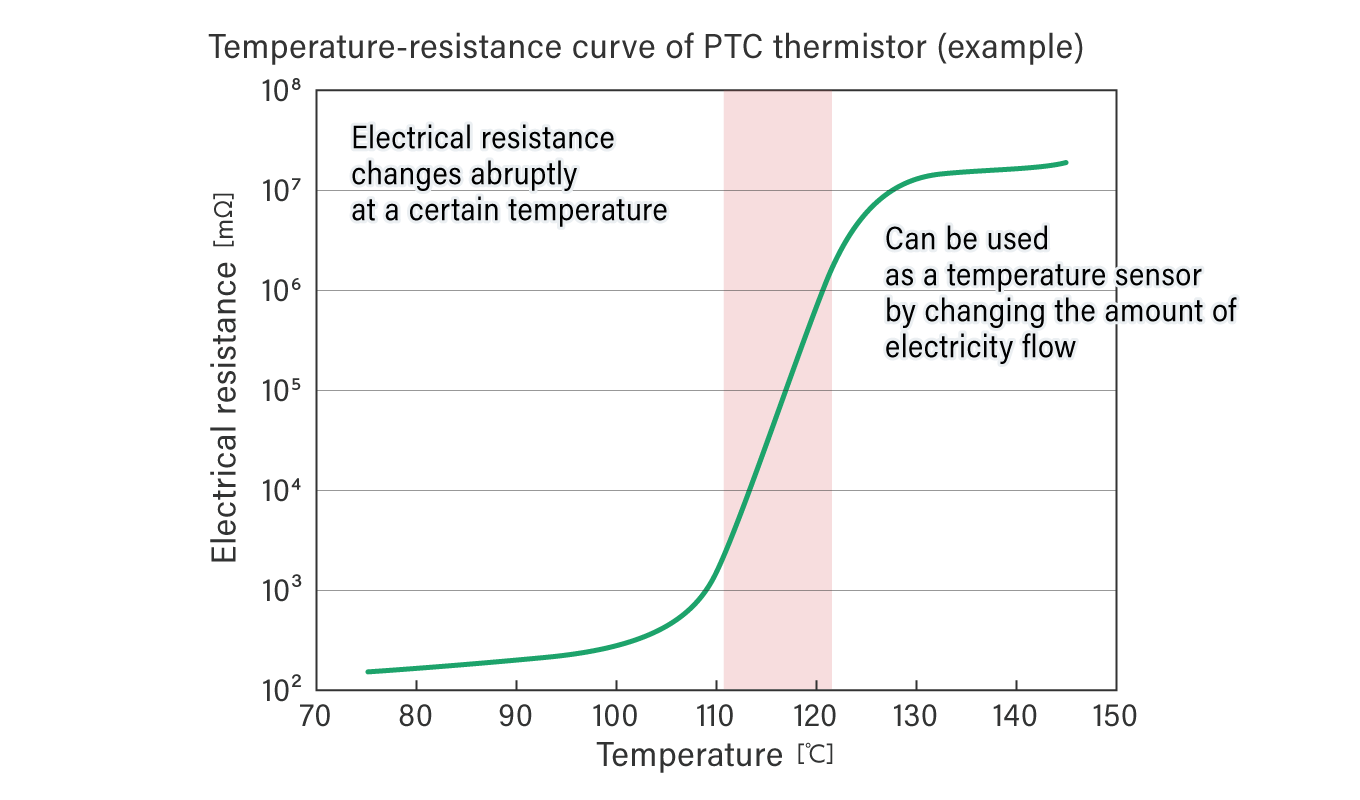
A new approach has led to a breakthrough in circuit interruption.
If a circuit is interrupted due to traditional sensor technology, it can be used again once the temperature returns to its original state. However, continuing to use a lithium-ion battery with existing defects is dangerous. Therefore, we shifted our focus to developing a product that can completely cut off the circuit in the event of overcharging or overcurrent when the primary protection function fails.

After multiple trials and errors, the solution was to add a heater to melt the fuse. This method can address both overcharging and overcurrent issues, while also physically interrupting the circuit.
The electrical structure of the SCP is shown in the circuit diagram below. On the left is a general circuit diagram, and on the right is a three-dimensional circuit diagram reflecting the internal structure of the SCP. The actual SCP structure consists of fuses arranged in a three-dimensional cross pattern on top of the heater (resistor).
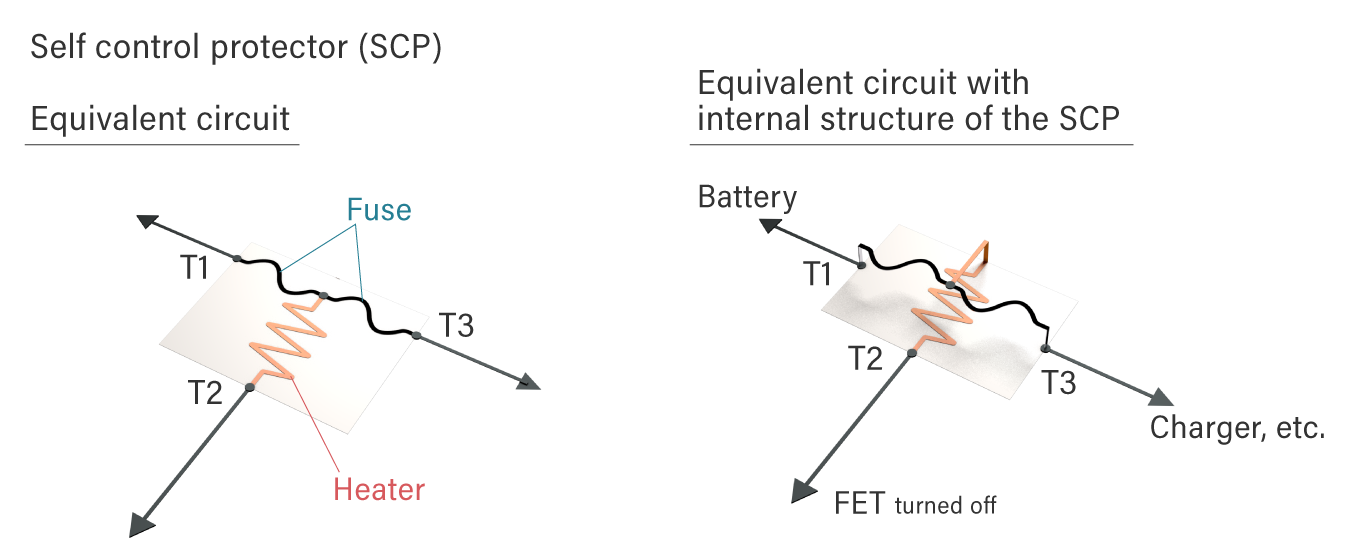
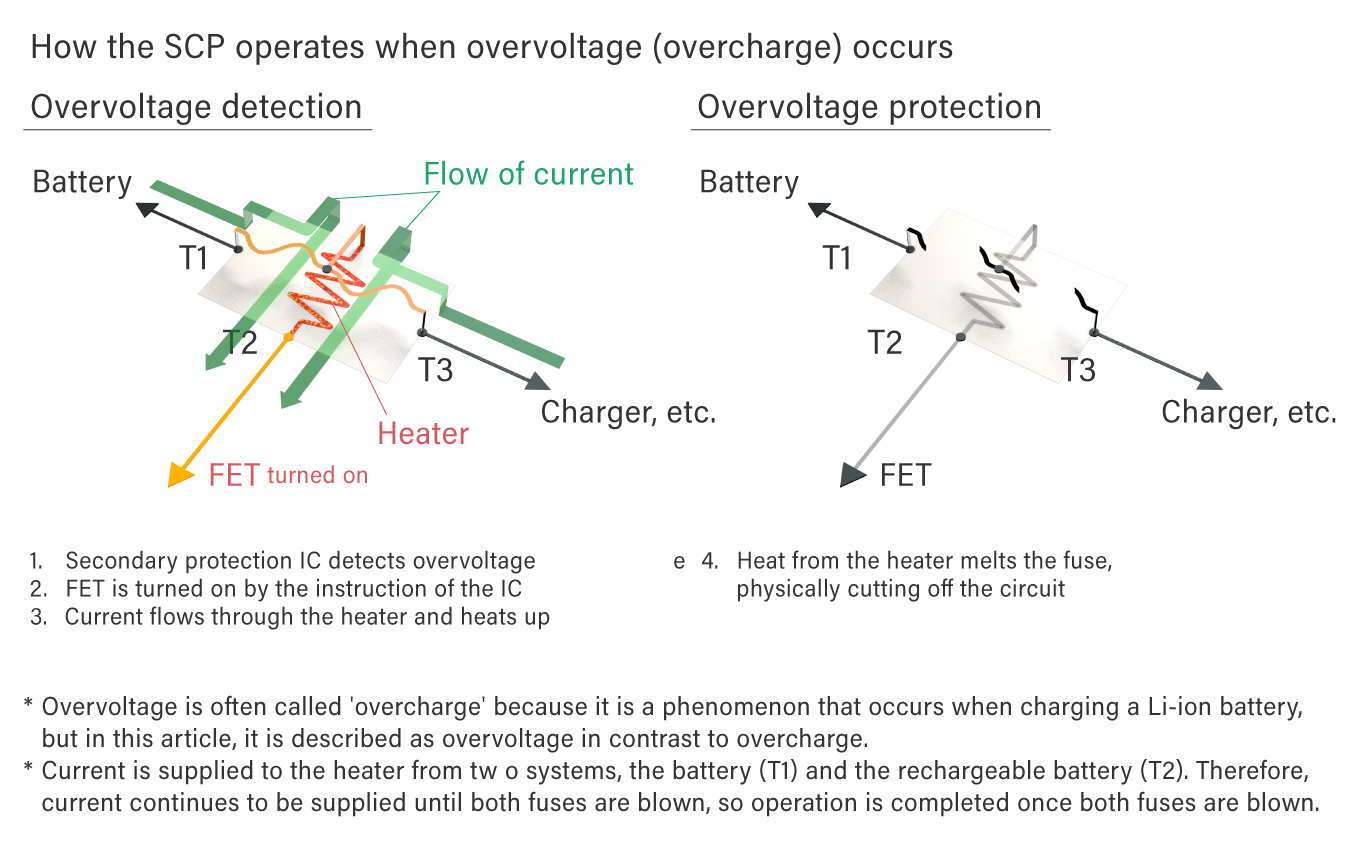
The chart below explains how SCP operates.
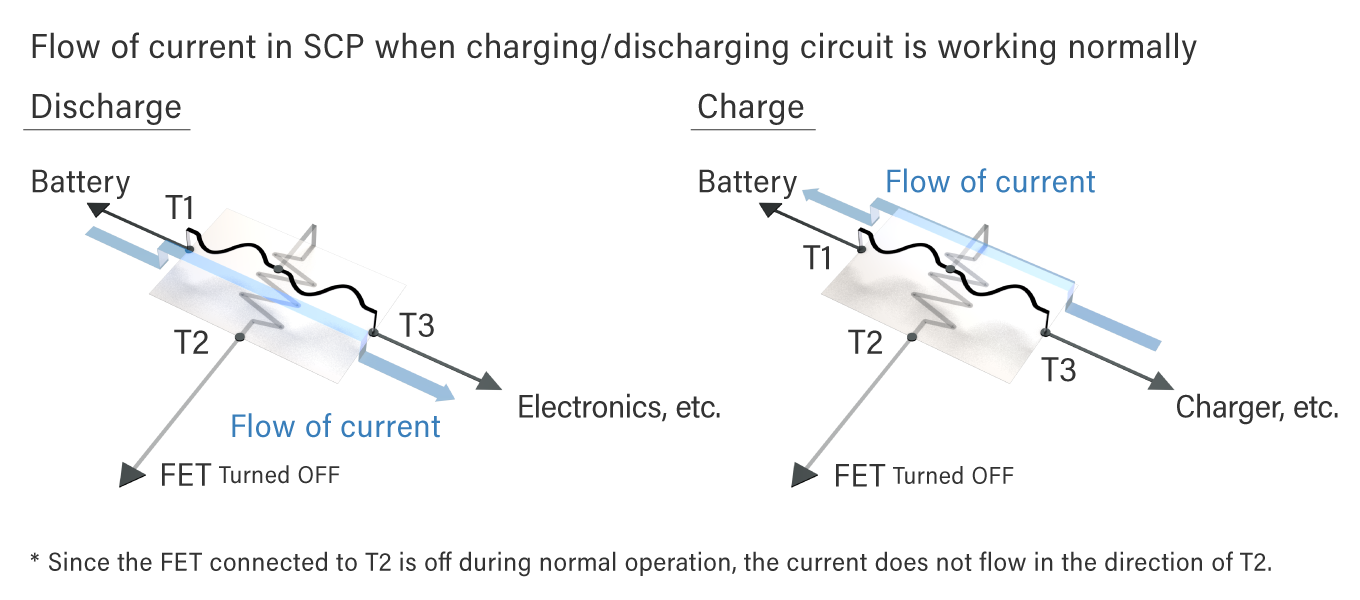
The current during normal discharge and charging is as shown below.
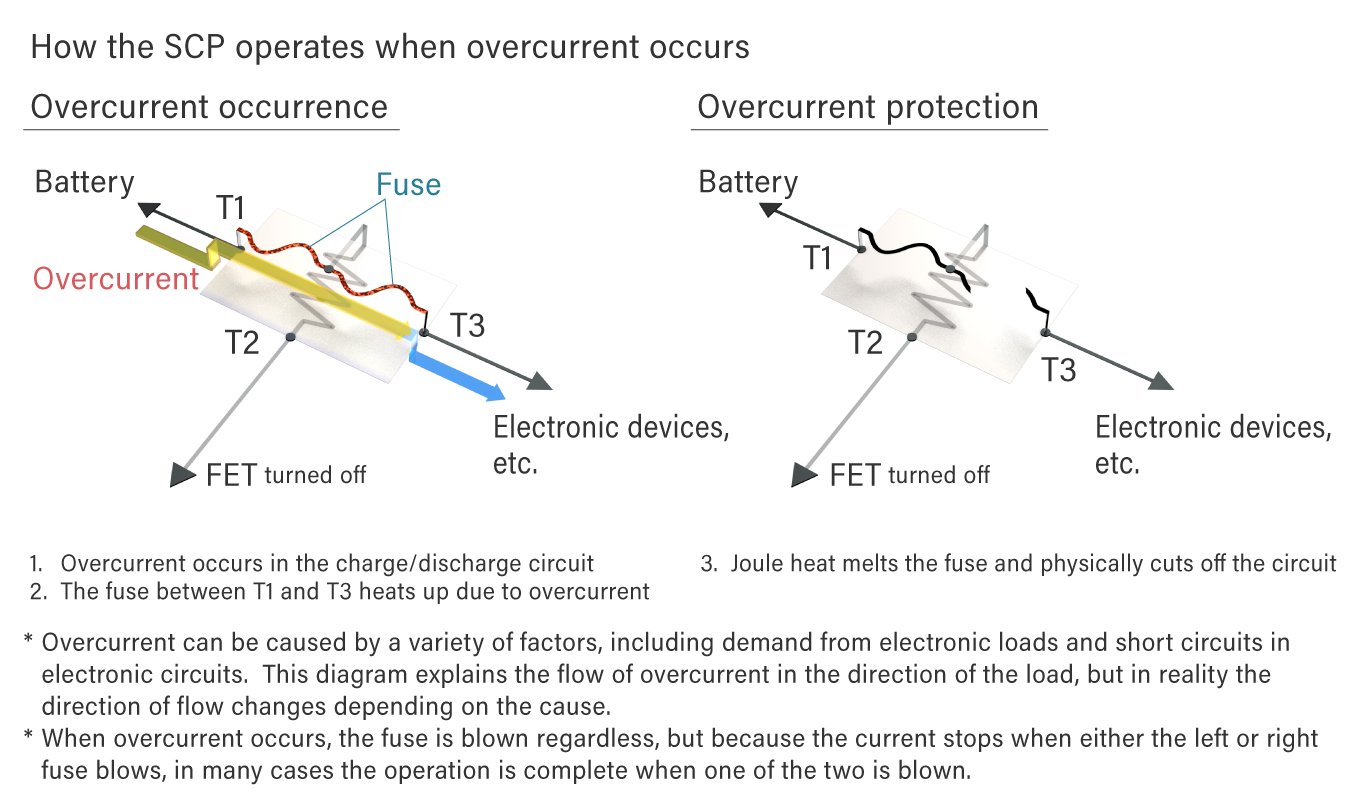
When an overcurrent occurs, the fuse element melts due to Joule heat, thereby cutting off the circuit.
When overcharging occurs, the secondary protection IC detects the anomaly and activates the FET, thereby initiating the heating circuit. In this situation, current flows to the heater simultaneously through T1 and T3, generating heat. This heat is transferred to the fuse element, causing the fuse to melt and interrupt the circuit. At the same time, the heating circuit is disconnected, and heat generation stops.
Initially, flexible printed circuit boards (FPC) were used as the base material for circuits, but to accommodate surface mounting, the base material was replaced with ceramic substrates. Eventually, we completed the prototype of SCP.
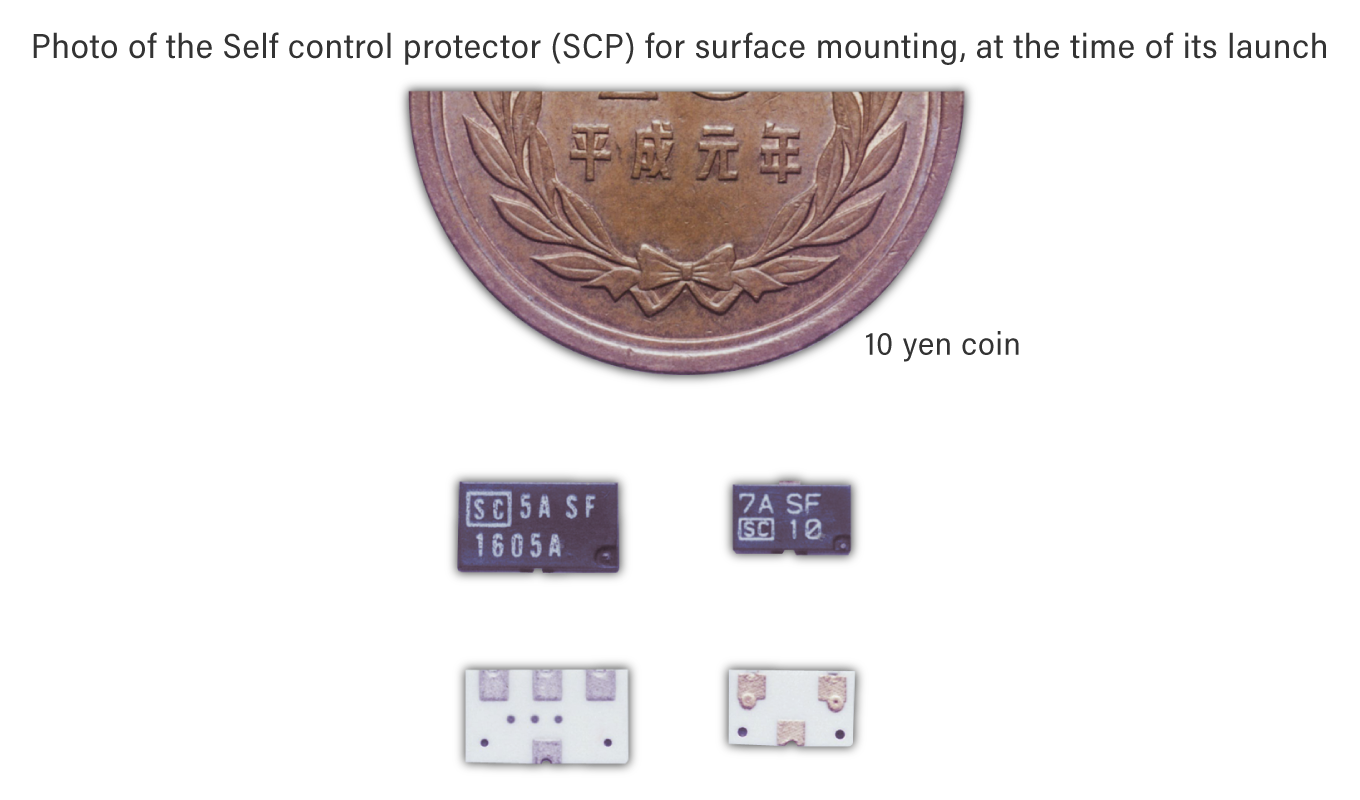
The continuously growing demand for lithium-ion batteries and SCP.
In 1994, we obtained the fundamental patent for the laminated structure of SCP heaters and fuses. In the same year, a lithium-ion battery equipped with SCP in its secondary protection circuit was launched. Lithium-ion batteries with SCP were quickly adopted by many computer manufacturers. Today, Dexerials' SCP continues to be widely used as a fuse in the secondary protection circuits of many products, including laptops.
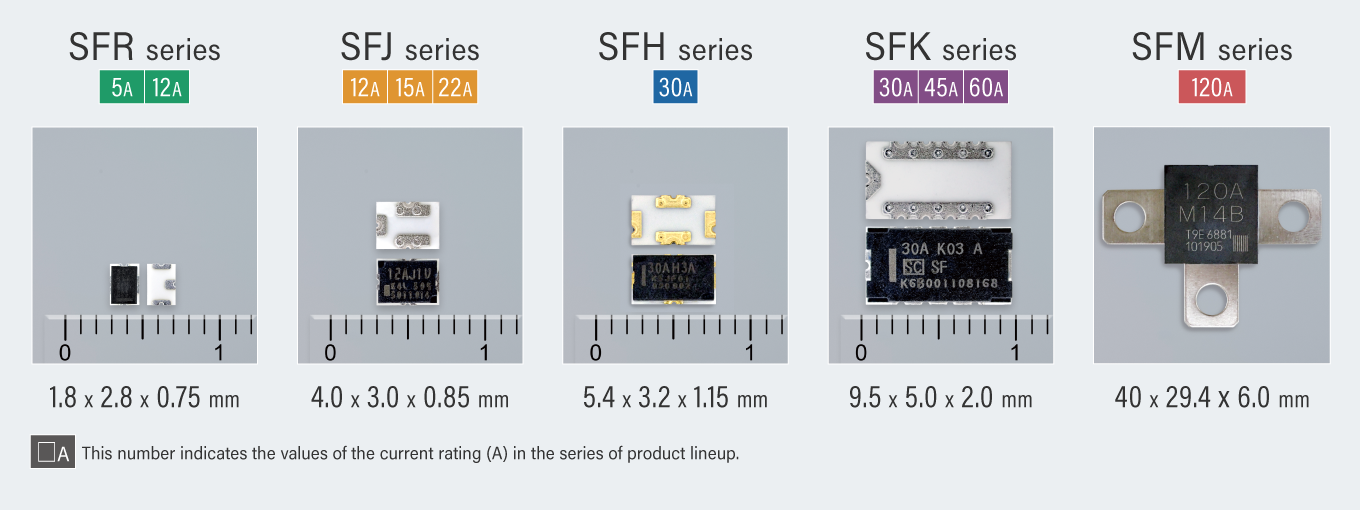
As the lithium-ion battery market expands, the demand for SCP has also increased. Nowadays, these batteries are used in large electrical products such as laptops, wireless tools, industrial batteries, and electric vehicles. For smaller devices, they are utilized in laptops, tablets, fast-charging smartphones, and AEDs for medical equipment. As the world begins to shift from gasoline engines to electric motors, SCP will also need to handle higher voltages in larger devices.
Technology continues to advance rapidly. Dexerials will also continue to develop products to meet various market demands.