


ACF is crucial for fine-pitch connections in high-definition flat panel displays.
Flat panel displays used in smartphones, tablets, and large-screen TVs are gradually advancing toward higher resolutions every year. As the functionality of digital devices diversifies, the density of their components continues to increase. These trends have led to a growing demand for precision-pitch connections to electrically and mechanically link the glass substrates and IC chips that make up the displays.
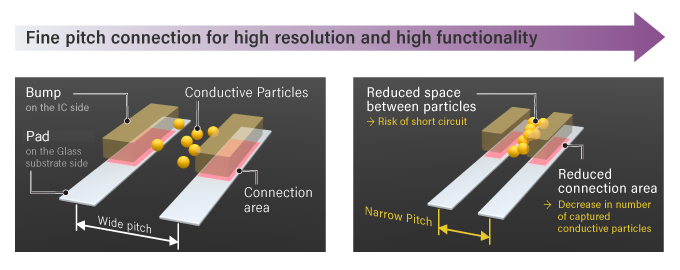
In 1977, Dexerials commercialized Anisotropic Conductive Film (ACF), an adhesive used for bonding IC chips. Today, it is widely used to bond IC chips to the glass substrates of smartphones and tablets. ACF is composed of conductive particles dispersed in a thermosetting resin. When using ACF, multiple electrodes can be connected simultaneously by applying heat and pressure. The conductive particles in ACF are coated with insulating material. When the pads being bonded capture these particles, the coating is broken, forming an electrical connection between the pads. Uncaptured particles retain their insulating properties, preventing short circuits between adjacent pads.
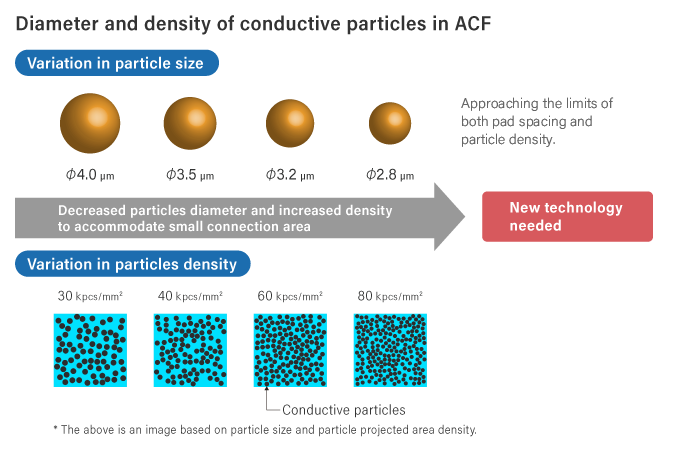
ACF has quickly gained popularity because it is more suitable for fine-pitch connections compared to welding or mechanical connections. Dexerials has reduced the size of conductive particles in ACF and increased their quantity to meet the demand for finer-pitch connections and smaller connection areas.
Traditional ACF (Anisotropic Conductive Film) contains dispersed particles within the resin. As the number of particles per unit area increases, the probability of capturing particles also rises. However, with the growing demand for high-resolution displays and the reduction in connection area due to increased component density, this approach began to reach its limits in the 2010s. Excessive particles can cause blockages between pads, thereby increasing the risk of short circuits.
Breakthroughs in 'aligning' and 'repairing' conductive particles
The question is: "How can finer spacing connections be achieved without changing the size or increasing the number of particles?" Dexerials' solution is: "Instead of increasing the number of particles, reduce the number of conductive particles and arrange them uniformly at the target positions." The following images show a comparison of particle distribution between Dexerials' traditional ACF and the "Particle-Aligned ACF" developed in 2014. The particles in traditional ACF are randomly distributed, whereas the particles in "Particle-Aligned ACF" are uniformly spaced and aligned.
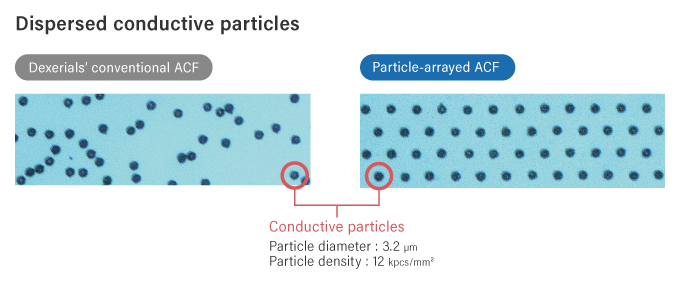
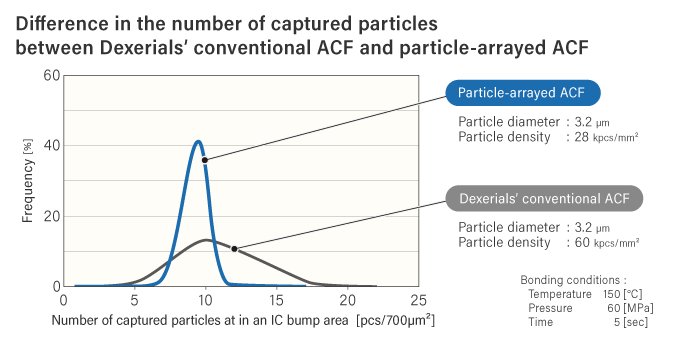
By arranging the conductive particles in an orderly manner with regular intervals in this way, it is possible to stabilize the number of particles captured in the spacer, even with the same number of particles per unit area, thereby ensuring reliable conductivity. In traditional ACFs, when heat and pressure are applied, the resin softens and flows toward low-pressure areas (i.e., spaces without spacers). The flow of resin causes the conductive particles to move, reducing the number of particles in high-pressure areas (between opposing spacers) and increasing the number of particles in low-pressure areas (between adjacent spacers).
However, the newly developed 'Particle Array ACF' uses a resin that can suppress the movement of aligned particles. As a result, even with fewer particles, reliable conductivity can be ensured within small connection areas, and since the particles hardly move during the bonding process, the risk of short circuits is reduced. Dexerials has named this product, which utilizes particle array and fixation technology, 'ArrayFIXⓇ'.
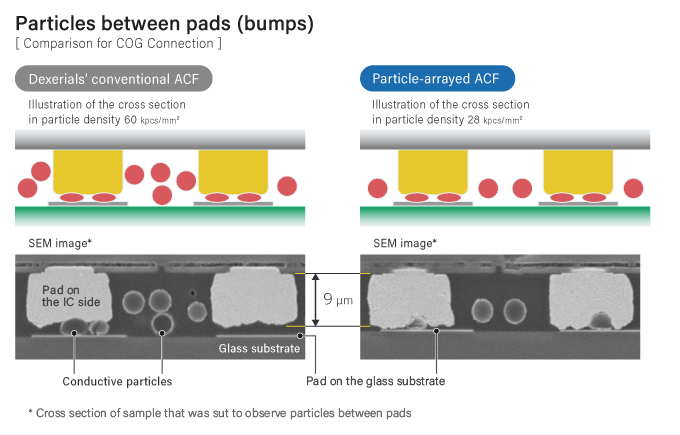
ArrayFIX® technology enables more precise spacing connections.
Below is a microscopic image showing an IC chip connected to a substrate using traditional ACF and particle-aligned ACF. The particle-aligned ACF on the right reduces the number of particles by 53% compared to traditional ACF, decreasing from 60,000 to 28,000. Additionally, the minimum connection area is reduced by 77%, from 1300 μm² to 300 μm², while the minimum pad pitch can be reduced by 17%, from 12 μm to 10 μm.
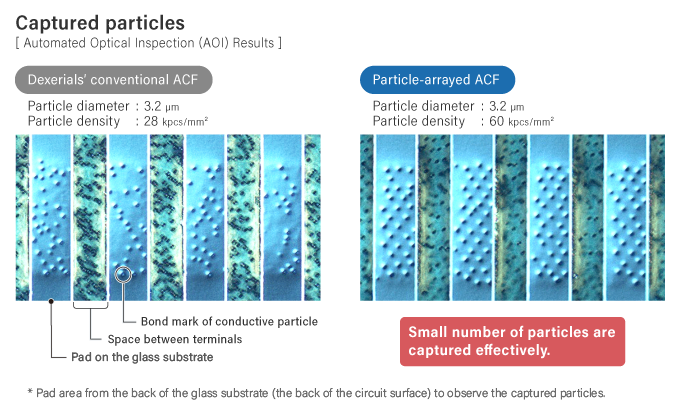
ArrayFIXⓇ, a particle-array type ACF, offers fine-pitch connections with a minimum bump pitch of 10 micrometers, providing highly reliable connections for IC bonding on high-resolution display panels. With advancements in 4K display technology and 5G communication, mobile devices are expected to be designed with higher resolutions and more refined display effects. ArrayFIXⓇ enables reliable connections for cutting-edge displays and supports the development of next-generation digital devices.