


What is Anisotropic Conductive Film (ACF)?
Anisotropic Conductive Film (ACF) is an adhesive used for securing and electrically connecting electronic components, such as integrated circuits (ICs), to circuit boards. ACF was originally introduced by Sony Chemicals (now Dexerials Corporation) in 1977 and has since become a crucial component in nearly all digital devices that use flat-panel displays, such as smartphones, tablets, and HDTVs.

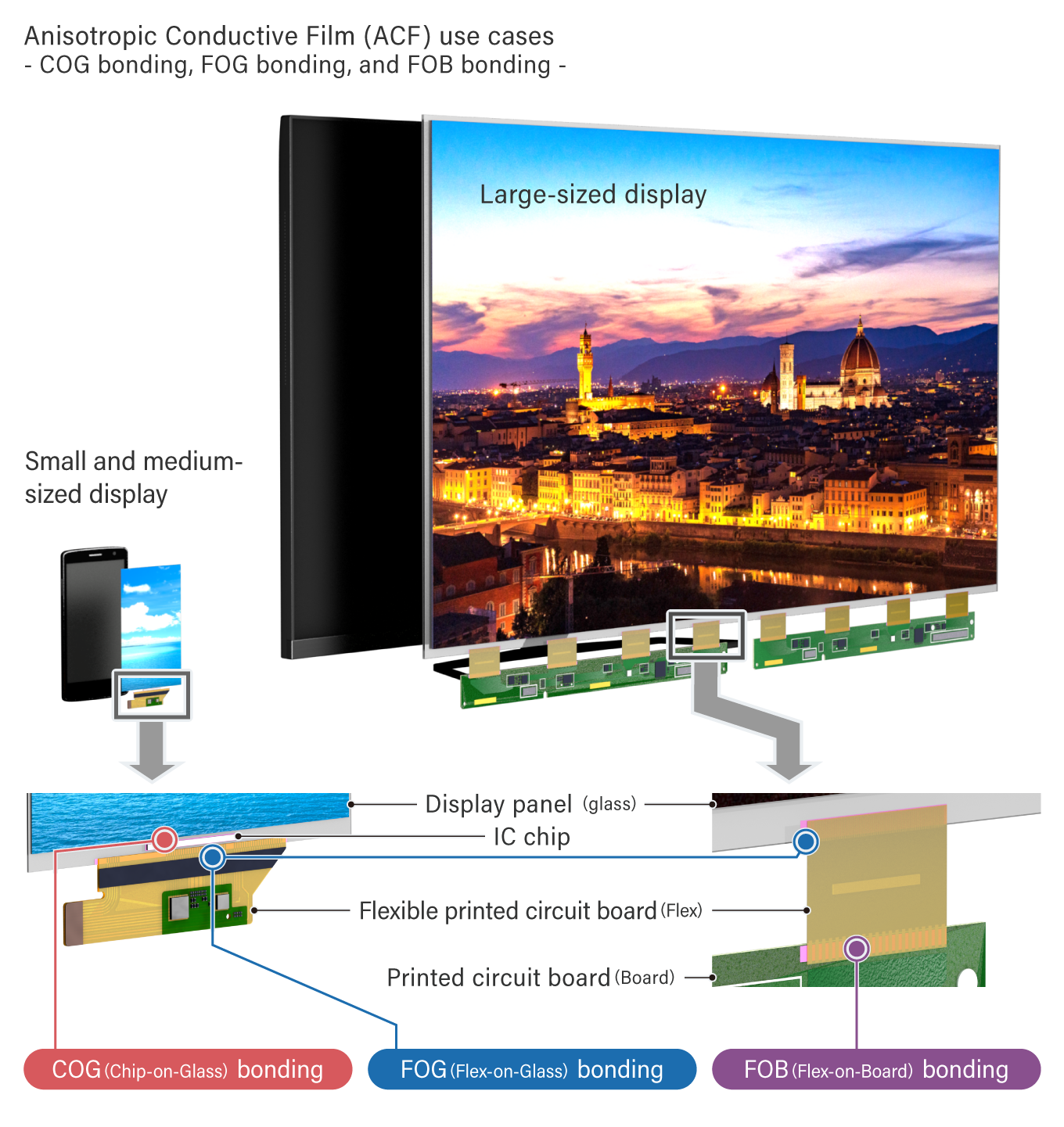
ACF is commonly used to connect display panels to flexible substrates that transmit signals to the panel or IC. Common applications of ACF include:
- COG (Chip on Glass), used for connecting ICs and glass substrates.
- FOG (Flexible Glass Bonding Technology), used for connecting flexible substrates and glass substrates.
- FOB (Flexible Board Bonding), used for connecting flexible substrates and rigid substrates.
Other applications of ACF also include smart cards and camera modules used for CCD (Charge-Coupled Device) and CMOS (Complementary Metal-Oxide Semiconductor).
How does ACF achieve bonding, conductivity, and insulation?
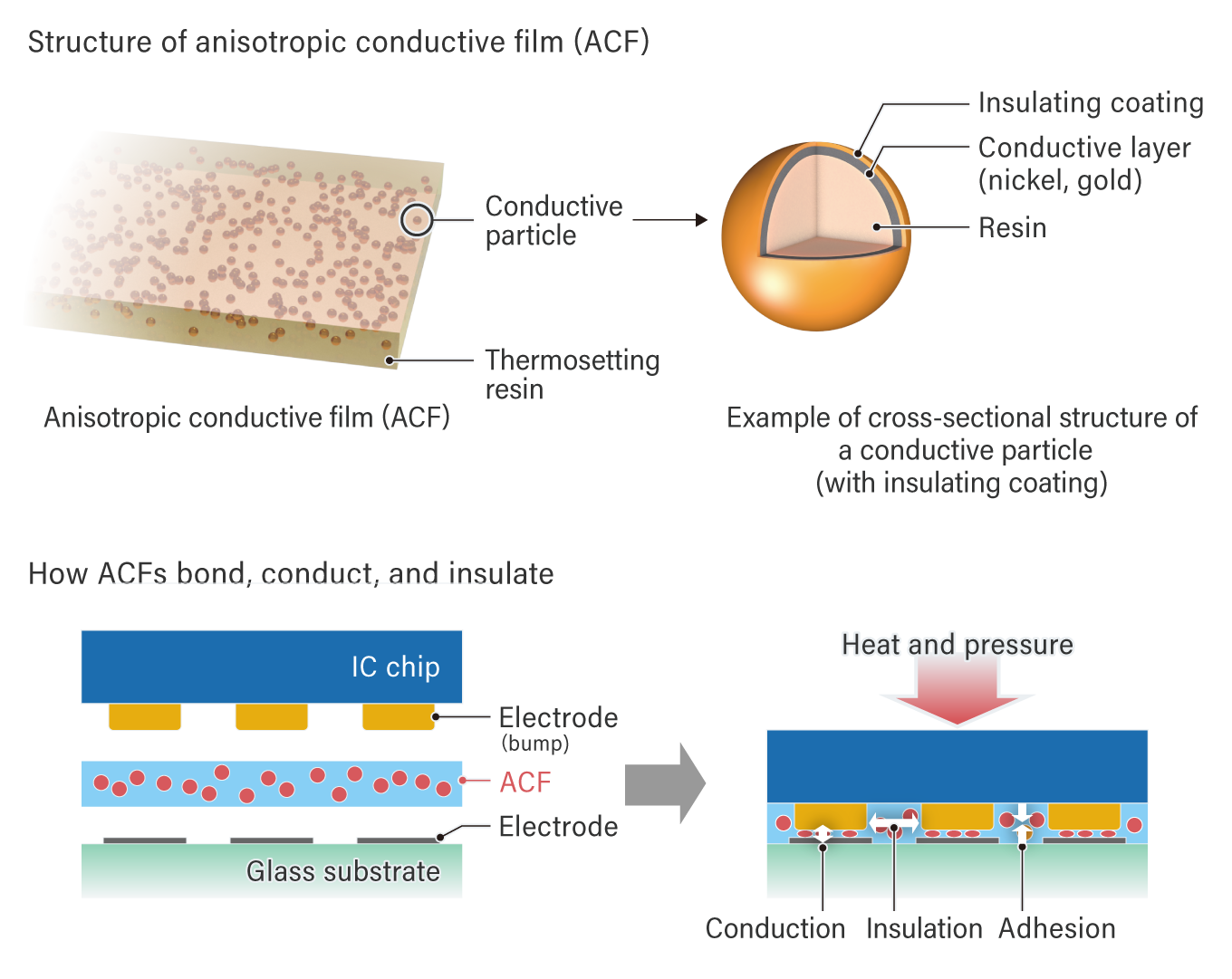
ACF has three main functions: bonding, conductivity, and insulation. One notable advantage of ACF is its ability to simultaneously connect a large number of pads, enabling finer pitch connections compared to traditional methods of soldering electronic components. Additionally, ACF can perform bonding at lower temperatures, with a temperature range of 110°C to 180°C.
ACF is composed of conductive particles dispersed in thermosetting resin. To meet different requirements, ACF contains various types of conductive particles. Typical conductive particle structures include polymers coated with nickel or gold, which enable efficient conductivity and are further covered with an insulating layer. When heat and pressure are applied, the corresponding pads capture the conductive particles, breaking the insulating layer and establishing electrical connections between the pads.
Particles not sandwiched between the pads will transfer within the base resin of the film between the pads, thereby maintaining the insulating coating and preventing short circuits. In the diagram below, the current between the pads and the substrate is conducted only in the vertical direction.
ACF structure and bonding process
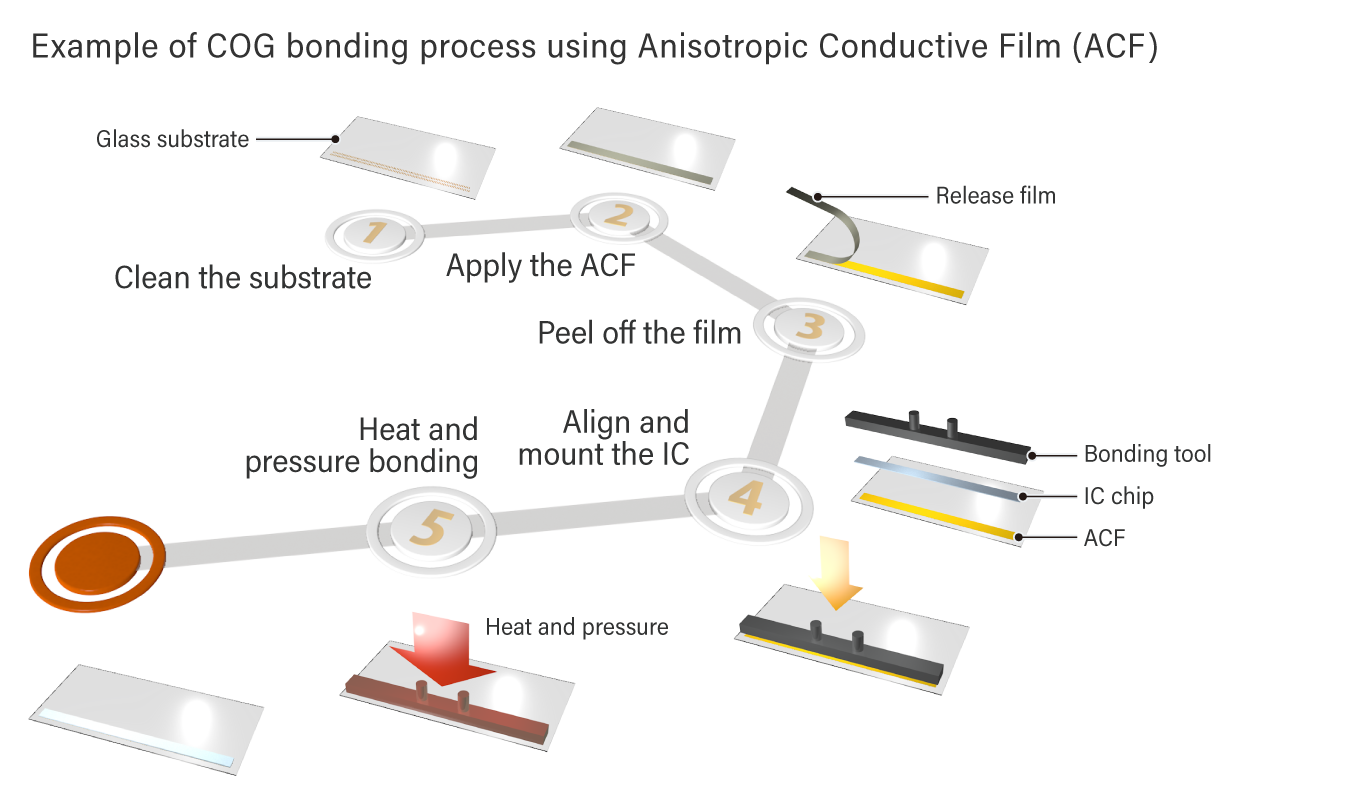
The following is the ACF bonding process:
Step 1: Clean the surface of the board that will be adhered.
Step 2: Apply heat and pressure while the ACF is still attached with the release film.
Step 3: Peel off the release film.
Step 4: Align the IC chip's pads with the ACF.
Step 5: Apply heat and pressure again.
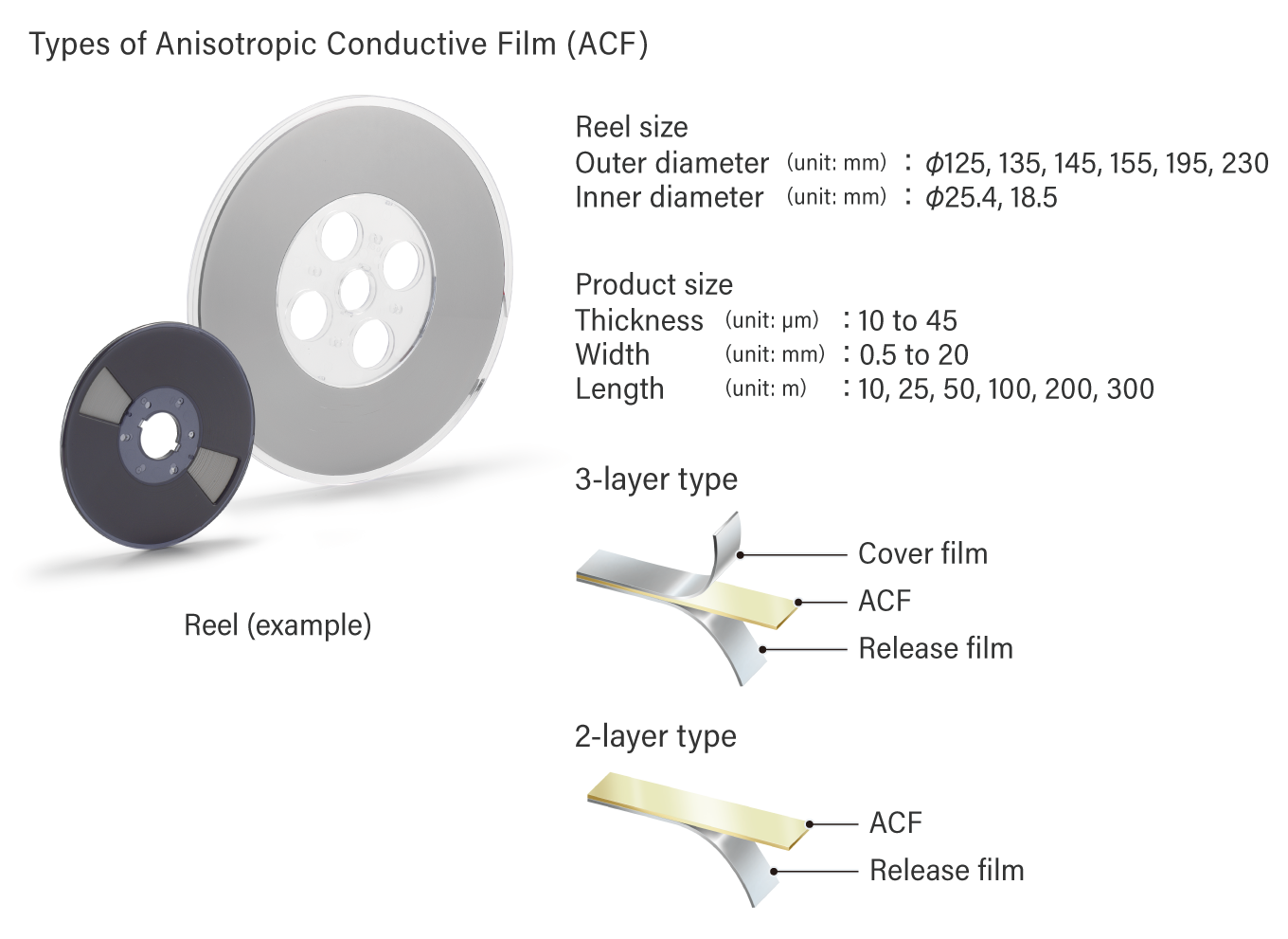
Dexerials' ACF is sold in roll form, as shown in the image below. Their film thickness ranges from 10 to 45μm, widths from 0.5 to 20mm, and lengths from 10 to 300m.
The diagram below illustrates two types of ACF: the three-layer type and the two-layer type. The three-layer type sandwiches the ACF between a protective film and a release film, while the two-layer type uses only a release film. Each type has its own advantages. The three-layer type reduces the risk of dust contamination, whereas the two-layer type eliminates the need to remove the protective film during the bonding process.
Advantages of using ACF bonding components
As technology continues to advance each year, the pitch between circuit board pins is becoming increasingly finer, the area of the connecting pads is shrinking, and the spacing between pads is narrowing. While reflow soldering and connector assemblies have traditionally been used to connect electronic components like ICs to circuit boards, ACF offers a solution to these trends.
However, one drawback of ACF is that it poses challenges when connecting components of different shapes simultaneously, which is common in reflow soldering. Additionally, since ACF is an adhesive, it cannot be freely detached and reconnected like a connector.
Benefits of ACF
- Components can be bonded onto a glass substrate.
- Support batch connection of multiple spacers
- Achieve precise spacing connection
- Lead-free
- Quick bonding at relatively low temperatures
- Thinner bonding area
The history and innovations of ACF
Since its introduction in 1977, Dexerials has been continuously improving ACF. The conductive particles initially used were carbon fibers and solder particles. However, in 1988, Dexerials developed nickel-plated and gold-plated particles. By the 1990s, Dexerials successfully developed a technology to coat the surface of particles with insulating materials.
As digital devices evolve toward higher resolutions, Dexerials has adapted to the trend of fine-pitch connections by reducing particle size from 5μm to 2.8μm. In 2014, Dexerials developed a technology to uniformly arrange conductive particles in thermosetting resin, and in 2016, launched the product under the name 'Particle'.AlignmentTypeAnisotropic conductive film(ArrayFIX) is officially introduced to the market. This product facilitates the miniaturization and lightweight design of digital devices, as well as higher resolution displays.
Choose the best type of ACF
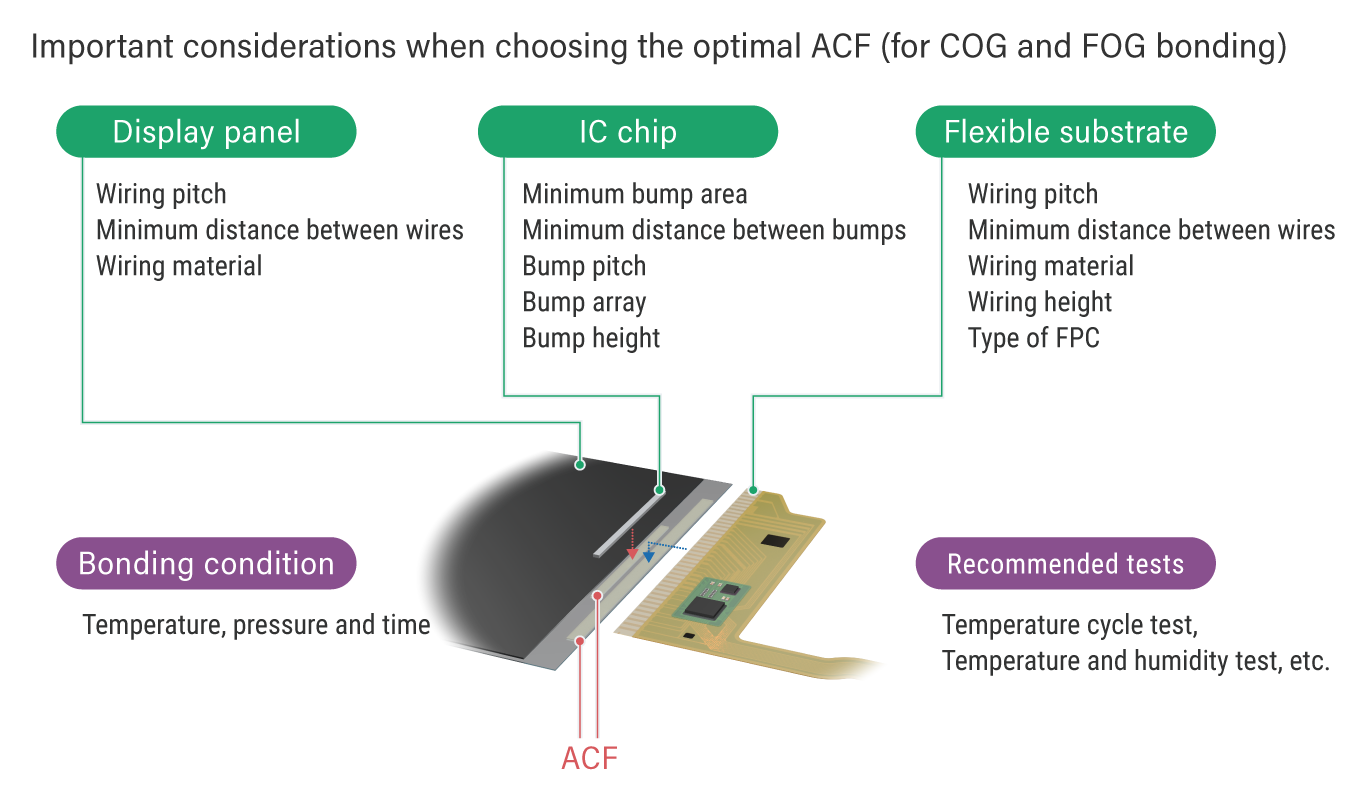
When selecting the best ACF, multiple factors should be considered, including the type of adhesive material, the bonding area, the distance between pads, the height of the pads, and heat resistance.
ACF is composed of epoxy resin or acrylic resin and is cured by heating.
In scenarios where it is necessary to bond flexible printed circuits (FPC) to substrates (PCB or glass substrates) and reworkability after bonding is a primary consideration, Dexerials recommends using acrylic ACF. (Please note that Dexerials itself does not recommend rework. Dexerials advises rework only after conducting reliability evaluations and ensuring there are no issues.)
If rework is likely to be required by the customer, Dexerials does not recommend using epoxy resin-based ACF. The main reason is that it often damages the substrate that needs rework. This is because cured epoxy resin cannot dissolve in solvents, and the rework process requires scraping off the residue.
During rework, it is usually necessary to use tools such as a heat gun, soldering iron, or heating plate to heat the bonding area before peeling off the FPC. Afterward, solvents like methyl ethyl ketone (MEK) or N-methyl-2-pyrrolidone (NMP) and cotton swabs should be used carefully to remove cured resin residues between the circuit board pads. However, Dexerials does not recommend reusing the FPC, as the FPC typically curls during the peeling process, and cleaning the resin residues between the pads on the FPC side is very challenging.
With over 40 years of leadership in the ACF technology field, Dexerials can provide services including initial setup, recommending suitable ACFs, as well as post-connection analysis and evaluation. If you have any questions about the application of ACF, please feel free to contact Dexerials.