


A pressure sensor is a device used to measure the pressure of liquids and gases. Similar to other sensors, a pressure sensor operates by converting pressure into an electrical signal output.
2. Classification of Pressure Sensors
Pressure sensors vary significantly in terms of technology, design, performance, operating conditions, and cost. It is roughly estimated that there are over 60 types of pressure sensor technologies and at least 300 companies worldwide manufacturing pressure sensors.
Pressure sensors can be classified based on the pressure range they can measure, operating temperature, and pressure type, with the most important being the pressure type. Based on pressure type, pressure sensors can be categorized into the following five types:
① Absolute pressure sensors
② Gauge pressure sensors
③ Vacuum pressure sensors
④ Differential pressure sensors
⑤ Sealed pressure sensors
Based on structure and principle, they can be divided into: strain gauge, piezoresistive, capacitive, piezoelectric, and resonant pressure sensors. Additionally, there are optoelectronic, fiber optic, and ultrasonic pressure sensors.
1. Strain gauge pressure sensors
2. Piezoresistive pressure sensors
3. Capacitive pressure sensors
4. Piezoelectric pressure sensors
5. Inductive pressure sensors
6. Hall effect pressure sensors
7. Eddy current pressure sensors
8. Vibrating wire pressure sensors
2.1 Pressure Sensor Parameters:
- Capacity
- Rated output (Sensitivity)
- Non-linearity
- Repeatability
- Creep
- Hysteresis
- Zero balance
- Input resistance
- Output resistance
- Insulation impedance
- Operation temperature range
- Compensated temperature range
- Temperature effect on zero
- Temperature effect on output
- Safe load limit
- Ultimate overload
- Excitation voltage
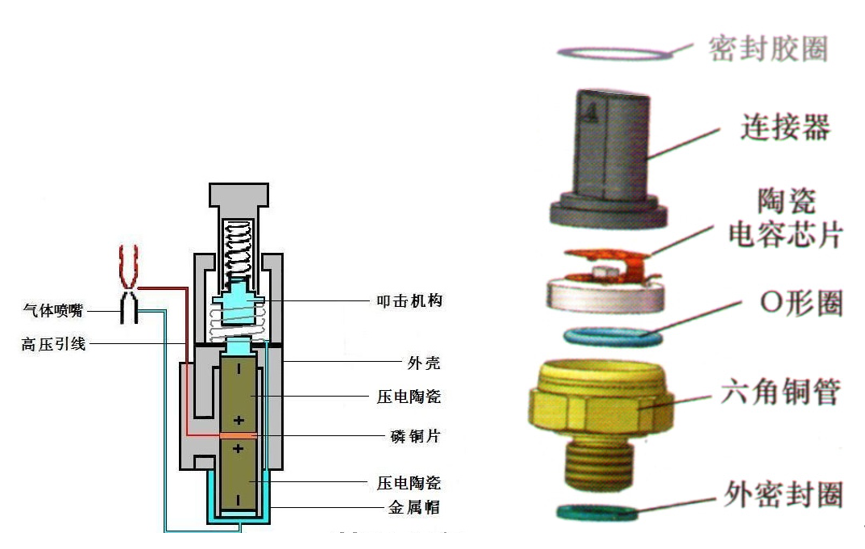
2.2 Internal Structure of Pressure Sensors
2.3 Classification of Sensor Cores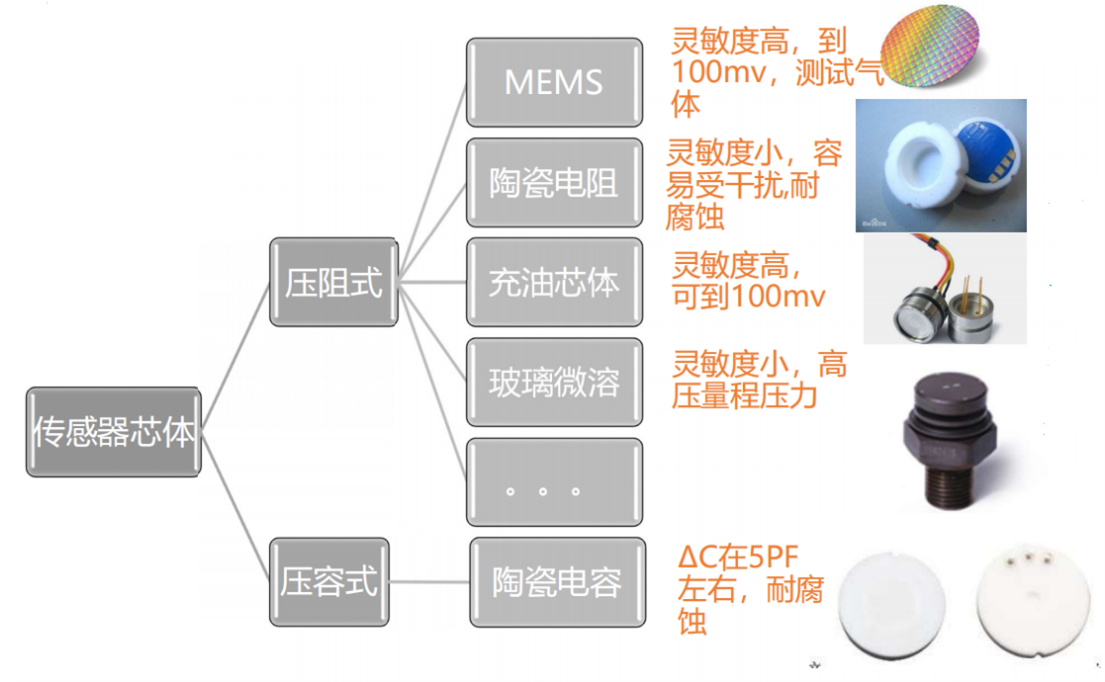
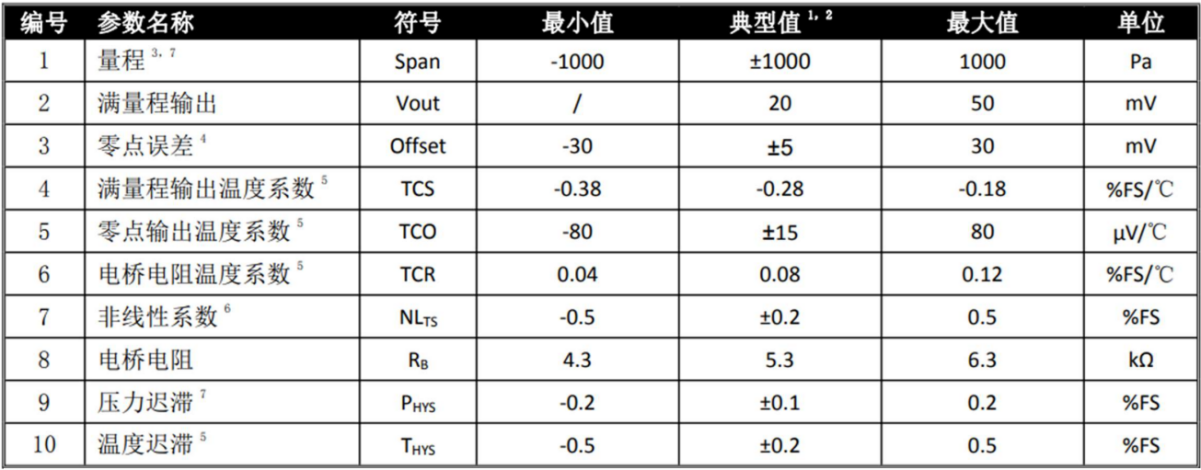
2.4 Sensor Core Parameters
2.5Principles of Sensor Cores
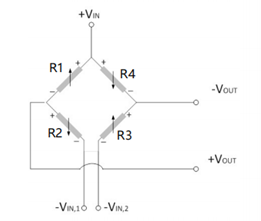
Piezoresistive Core
Capacitive Core
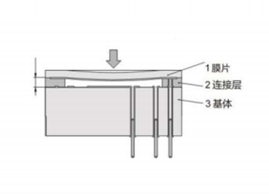
3. Applications of Pressure Sensors
Pressure sensors can directly convert the measured pressure into various forms of electrical signals, making it convenient to meet the requirements of centralized detection and control in automated systems. As a result, they are widely used in industrial production.
Pressure sensors are extensively used in many monitoring and control applications. In addition to direct pressure measurement, they can also be used for indirect measurement of other quantities, such as the flow rate of liquids/gases, velocity, water level, or altitude.
Additionally, some pressure sensors are designed for dynamic measurement of rapidly changing pressures. Examples include monitoring combustion pressure in engine cylinders or gas pressure in turbine engines. Such sensors are typically made of piezoelectric materials, such as quartz.
Certain pressure sensors, such as those used in traffic enforcement cameras, operate in a binary manner. That is, when the pressure reaches a certain value, the sensor controls the circuit to turn on or off. These types of pressure sensors are also known as pressure switches.
Main applications include:
1. Hydraulic systems
2. Safety control systems
3. Injection molds
4. Monitoring mine pressure
5. Compressors and air conditioning equipment
4. Introduction to NSA9260X/NSA2860
4.1 NSA9260X: Bridge Automotive Pressure Sensor Conditioning Chip
The NSA9260X is a high-integration chip designed for bridge automotive pressure sensor signal conditioning, meeting the AEC-Q100 standard with enhanced EMC performance. It features a high-precision variable gain instrumentation amplifier and a 24-bit ADC for the main signal measurement channel, as well as a 24-bit ADC for auxiliary temperature measurement. With an integrated MCU, the NSA9260X supports second-order temperature drift calibration for zero and sensitivity, as well as up to third-order non-linearity calibration, achieving calibration accuracy within 0.1%. Calibration coefficients are stored in a reprogrammable EEPROM. The NSA9260X supports overvoltage and reverse voltage protection, JFET high-voltage power supply, or direct high-voltage power supply. It offers multiple output modes, including analog voltage and PWM output, and supports sensor diagnostics.
4.2 NSA2860: General Sensor Conditioning and Transmitter Chip
The NSA2860 is a high-integration chip designed for resistive or voltage-type sensors, such as resistive pressure sensors, thermocouples, RTDs, etc., for signal conditioning and transmitter output. It integrates an external JFET controller, 24-bit main signal measurement channel, 24-bit auxiliary temperature measurement channel, sensor calibration logic, dual constant current sources, and other circuits. It supports various output modes, including digital interface output, analog voltage output, 4~20mA transmitter output, and PWM/PDM output. Its high integration and clever interface design allow the NSA2860 to achieve pressure or temperature transmitter calibration and transmission with minimal external components. With an integrated MCU, the NSA2860 supports second-order temperature drift calibration for zero and sensitivity, as well as up to third-order non-linearity calibration, achieving calibration accuracy within 0.1%. Calibration coefficients are stored in an EEPROM.
⚫ Analog Features
5. References:
[1] https://zhuanlan.zhihu.com/p/134586354
[2] NSA9260X Datasheet Rev1.2CN
[3] NSA2860 Datasheet Rev2.0_CN
[4] Training on Naixinwei Pressure ASIC and MEMS Pressure Sensor Applications
https://zhuanlan.zhihu.com/p/143618392
Feel free to leave a comment below the blog, and we will respond to your questions promptly. For further inquiries, please contact the ATU department of WPI Group: atu.sh@wpi-group.com
Author: Naib Zhou / Zhou Tiantian