


Currently, laptop memory is facing challenges. The traditional SODIMM module (a smaller version of desktop memory sticks) has been in service for nearly 25 years and is approaching a speed bottleneck. Additionally, it occupies a significant amount of motherboard space and thickness, which has long been a concern in the industry. CAMM2 is a new memory module standard that is expected to gradually replace the SODIMM memory, which has been in use for about 25 years. However, due to the widespread adoption and large user base of SODIMM, coupled with the cost advantages of soldered memory, this transition may take a long time. Nevertheless, CAMM2 demonstrates performance advantages over SODIMM.
Before CAMM2, Dell had been developing an alternative solution called CAMM (Compression Attached Memory Module) over the past few years. Unlike traditional memory sticks, CAMM modules directly mount memory chips onto the motherboard, occupying less space. Additionally, the shorter connection path to the CPU offers potential speed improvements and significant power consumption reductions. Dell tested a non-standard CAMM module in its Precision 7670 laptop in 2022. In December 2023, JEDEC released the CAMM2 memory module standard. "CAMM" is a generic term describing the module category. CAMM2 is the JEDEC-standardized version, while earlier versions of CAMM were proprietary to Dell.
CAMM2 comes in two specifications: DDR5 and LPDDR5(X), which are not interchangeable due to differences in connector pin arrangements. The CAMM2 standard includes two distinct module types:
- CAMM2: Equipped with DDR (Double Data Rate) memory chips, targeting high-end laptops such as gaming laptops and high-performance mobile workstations.
- LPCAMM2: Configured with LPDDR (Low Power Double Data Rate) memory chips, primarily aimed at ultrathin laptops and tablets.
CAMM2 modules are mainly targeted at the high-end market. As of now, only Dell has introduced laptops with CAMM2 modules, and this was back in 2022—before the CAMM2 standard was officially established. Therefore, even though these modules fully align with the CAMM2 standard, Dell still refers to them as CAMM.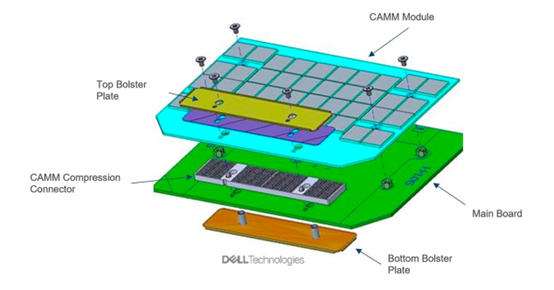
CAMM2 Memory Module Diagram
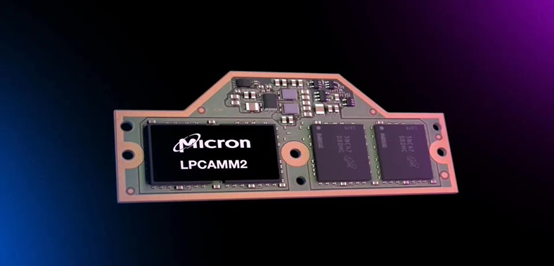
At this year’s CES in Las Vegas, Micron announced the launch of the industry’s first standard Low Power Compression Attached Memory Module (LPCAMM2), which uses LPDDR5X memory with capacities ranging from 16GB to 64GB. This module offers higher performance and energy efficiency for PCs, saves more space, and features a modular design.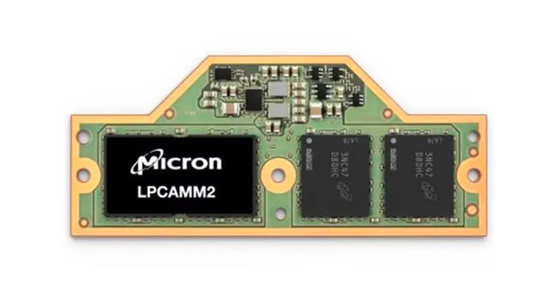
Micron LPCAMM2 Memory Module
Advantages of CAMM2 over SODIMM:
|
Feature |
CAMM2 Memory |
SODIMM Memory |
|
Module Type |
DDR/LPDDR |
DDR |
|
Single/Dual Channel |
Single module supports dual channel |
Single module supports single channel only |
|
Thickness |
Thinner |
Thicker |
|
Capacity |
Up to 128GB per module |
Up to 32GB per module |
|
Maximum Speed |
DDR5: 9600MT/s, |
DDR5: 6400MT/s |
|
Upgradability |
Removable |
Removable in some models |
1. While saving space, CAMM2 retains memory expandability. CAMM2 uses a new contact connector instead of a slot, making it 57% thinner than SODIMM and saving approximately 60% of motherboard space compared to dual-slot SODIMM. The CAMM2 memory measures 78mm in length and 29.6-68mm in width, and a single module supports dual channels.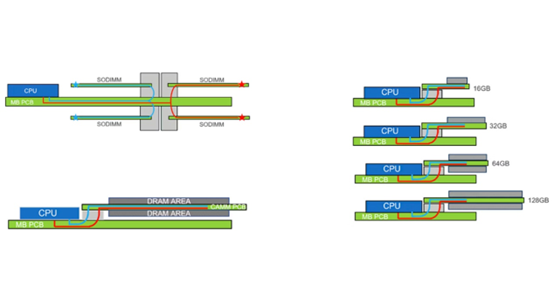
Thickness Difference Between SODIMM and CAMM2
2. Achieves stronger connectivity performance, addressing the interface bottleneck of SODIMM. Laptop SODIMM memory frequencies have maxed out at 6400MHz. The new LPCAMM2 memory module supports data transfer rates of up to 9,600 MT/s, significantly higher than the 6,400 MT/s of DDR5 SODIMM. Although LPDDR5X has higher latency compared to DDR5, its higher data transfer rates can offset this. Unlike soldered LPDDR5X memory subsystems, the modular form factor does not increase LPDDR5X memory latency.
Micron claims that its LPCAMM module with LPDDR5X memory is 64% smaller, consumes 61% less power, and delivers a 71% speed improvement in PCMark 10 basic performance tests compared to SODIMM memory. According to JEDEC, the CAMM2 standard supports DDR5 memory for mainstream machines and LPDDR5 and LPDDR5X memory for "a broader range of laptops and some server markets." LPDDR memory is more commonly used in laptops due to its ability to deliver high-speed data transfer at low power consumption.
3. Lower power consumption and better expandability. CAMM2 memory not only occupies less space on the laptop motherboard but also offers higher energy efficiency. With CAMM2 memory, manufacturers can have flexible expansion options in laptops, such as adding extra M.2 SSD slots or using the additional space for thermal optimization. Moreover, CAMM2 memory’s lower power consumption can significantly extend battery life.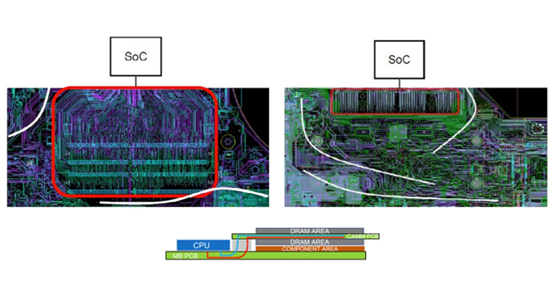
Using CAMM allows for more components to fit within the SoC
Unlike SODIMM memory, which can only use DDR chips, CAMM2 memory supports both DDR5 and LPDDR5X chips. This provides manufacturers with more options, enabling them to offer upgradable and replaceable CAMM2 memory instead of permanently soldering memory chips onto the motherboard, as is common in many ultrathin laptops and handheld PCs.
While CAMM2 has many advantages over SODIMM, it also has some notable drawbacks. First, CAMM2 memory is more expensive than SODIMM and soldered memory, which is one of its biggest challenges. For example, on Dell’s official website, a 32GB CAMM memory module with average speed costs as much as $500.
Although prices are expected to decrease with economies of scale and increased adoption of CAMM2, the current high costs will undoubtedly limit its application range.
Initially, it may only appear in high-end products. Secondly, in ultrathin laptops, the LPDDR CAMM2 solution may face competition from soldered solutions. This is because affordable 32GB memory is already being adopted in many ultrathin laptops this year, costing only about $50 more than 16GB. If the CAMM solution is significantly more expensive, soldered memory might be a more practical choice, as 32GB is sufficient for most users. Additionally, while CAMM2 saves space compared to SODIMM, it is still larger than soldered memory. Unlike the standardized dimensions of SODIMM memory sticks, CAMM2 dimensions are not fixed. To achieve a memory capacity of 128GB (78×68mm), sufficient motherboard space must be reserved, which may not save much area compared to SODIMM. In other words, while CAMM2 allows for upgrades, the maximum supported capacity depends on OEM design.
--------------------------------------------------------------------------------------------------------------------
Reference Links:
1. https://www.sysgeek.cn/camm2-ram/