Advantages of tantalum capacitors in ignition systems

Date2024-04-15

For modern detonation systems, molded tantalum (MnO 2 ) capacitors offer two main advantages. First, unlike aluminum electrolytic capacitors, they provide the high capacitance required by these compact systems. Second, unlike multilayer ceramic chip (MLCC) capacitors, tantalum capacitors exhibit excellent stability under voltage, temperature, and mechanical stress. Vishay offers a complete range of molded chip solid tantalum capacitors with capacitance values ranging from 0.1 μF to 1 mF and voltage ratings from 2 V to 75 V, available in various package sizes.


Detonation systems are critical components in mining, demolition, and quarrying. For decades, traditional detonators have been the preferred solution. While these systems are reliable and relatively inexpensive, they have significant drawbacks, including long setup times and potential safety risks to users and manufacturers if deployed improperly. With advancements in technology, electronic mining detonation systems have emerged, significantly reducing setup times and improving safety. The next-generation detonation systems under development are equipped with wireless communication technology used by submarines hundreds of meters below the surface. These new systems are no longer constrained by physical connections and can reliably transmit detonation signals wirelessly through rock, water, and air.

Like any electronic device, detonation systems require an internal power source to supply the system controller (MCU) and charge the ignition capacitors. To ensure precise timing and reliable detonation, capacitors are used as energy storage components for the detonation mechanism. Compared to other capacitor technologies, molded tantalum (MnO 2 ) capacitors can store charge (low leakage current) and have high energy density, making them ideal for electronic detonation systems. They allow for more time and higher voltage release to ensure proper detonation. For companies developing and manufacturing electronic detonation systems to meet mining application needs, this article introduces the advantages of tantalum capacitor technology.

Modern electronic detonators include delay modules designed for various explosive applications, ensuring precise and consistent detonation. With improved controllability, the safety of optimal timing detonation is also enhanced.
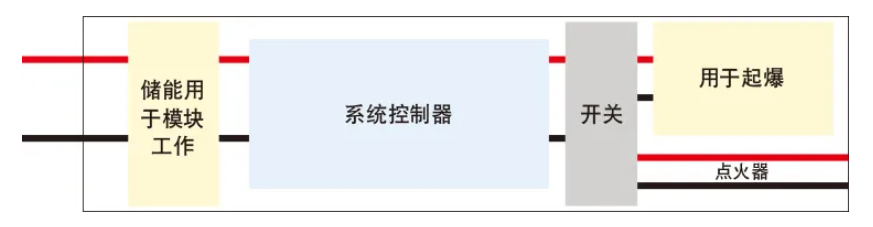
The basic structure of a wired electronic detonator is shown below.

The structure of an electronic detonator includes an insulated head to prevent accidental ignition of the explosive by external or transient voltages, a delay module to provide ignition signals from the main controller, and a detonation system consisting of an igniter, primary explosive, and secondary explosive. Inside the delay module, the MCU transmits signals to each capacitor to trigger ignition.


Depending on the design, one or two energy storage capacitors can be used for ignition. Therefore, capacitors play a crucial role. However, with a variety of capacitor technologies available, how should one choose the right capacitor for electronic detonators?


Using large DC/DC converters to step down high voltages (28 V or higher) to low voltages (3.3 V to 5 V) for MCU operation is impractical, making capacitors the ideal choice. Due to issues with size, cost, and/or stability, technologies such as aluminum, film, high-current power film, and wet tantalum are not optimal choices. Therefore, we recommend two capacitor technologies: solid tantalum or multilayer ceramic chip (MLCC) capacitors. Refer to Vishay's capacitor chart to compare the voltage-capacitance ranges of each technology.
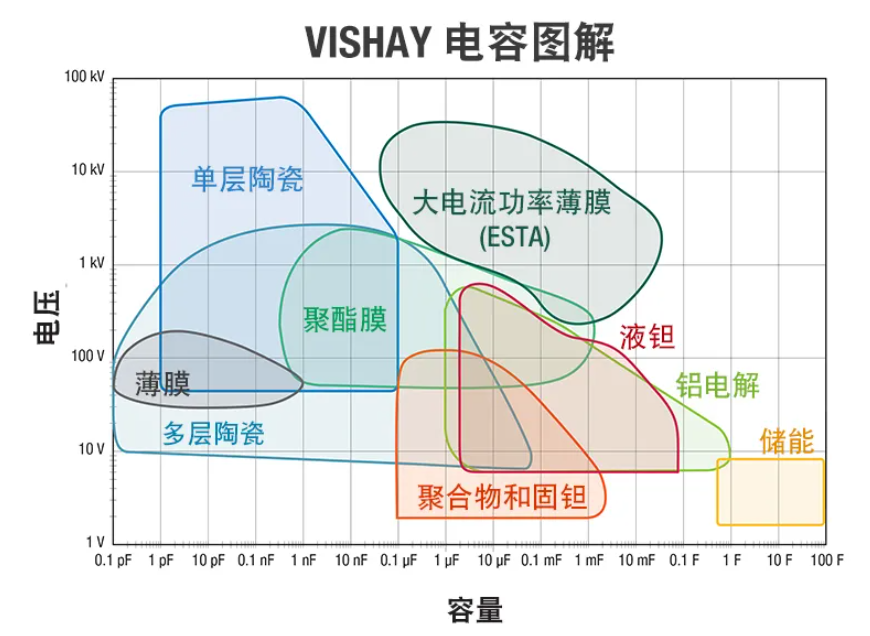
Although MLCCs offer a wide range of capacitance values and compact sizes, their capacitance-voltage (CV) volumetric efficiency is insufficient to support typical detonator applications.In addition to high CV, tantalum capacitors maintain stable capacitance values across the entire operating voltage and temperature range, ensuring consistent DC voltage output. Tantalum capacitors also exhibit strong resistance to mechanical shock.Finally, low leakage current (DCL) is another characteristic that makes tantalum capacitors an ideal choice. In comparison, for 12 V applications, MLCCs have nearly double the leakage current of equivalent tantalum capacitors, depending on the material and capacitance.For example, with a 25 V, 22 μF capacitor, which is the maximum CV achievable by MLCCs, according to Ohm's law, DCL(I) = V / IR (R).
MLCC performance is as follows:
MLCC insulation resistance (R): 50 Ω*F ÷ (22 x 10 -6 F) = 2.27 MΩ

DCL(I) = V / IR (R) = 12 V ÷ 2.27 MΩ = ~ 5.2 μA

Low Leakage Tantalum Capacitors:
DCL(I) = 0.005CV = 0.005 x 12 V x (22 x 10 -6 F) = 1.3 μA
These calculations are based on commercial material properties, with insulation resistance ranging from 50 Ω*F to 1000 Ω*F.


While many factors need to be considered when selecting capacitors for specific applications, Vishay tantalum capacitors stand out in performance for electronic detonators.
Data From Vishay https://mp.weixin.qq.com/s/isC196nInqQ3HIXiaEfpWg

★All content is provided by individuals and is unrelated to the platform. For any legal or infringement issues, please contact the Tech Highlights Exclusive Email