With the development of renewable energy, the application scenarios for DC-Link capacitors are becoming increasingly diverse. They are essential in fields such as photovoltaic inverters, new energy vehicles, charging stations, and UPS systems. DC-Link capacitors can smooth the DC voltage in circuits, provide short-term current reserves to handle transient load changes, and help reduce harmonics and electromagnetic interference in circuits, thereby improving the efficiency and reliability of power systems. Therefore, selecting the right DC-Link capacitor is crucial for these renewable energy-related applications.
Given the above application scenarios, the operation of DC-Link capacitors is typically handled by film capacitors. This is because, in addition to meeting the required performance standards, they generally offer better reliability and stability. Since applications like photovoltaic power generation and new energy vehicles often face harsh environmental conditions, the stability of key capacitor characteristics (such as ESR and capacitance) is particularly important to ensure the reliable and long-term operation of both the capacitor itself and the system.
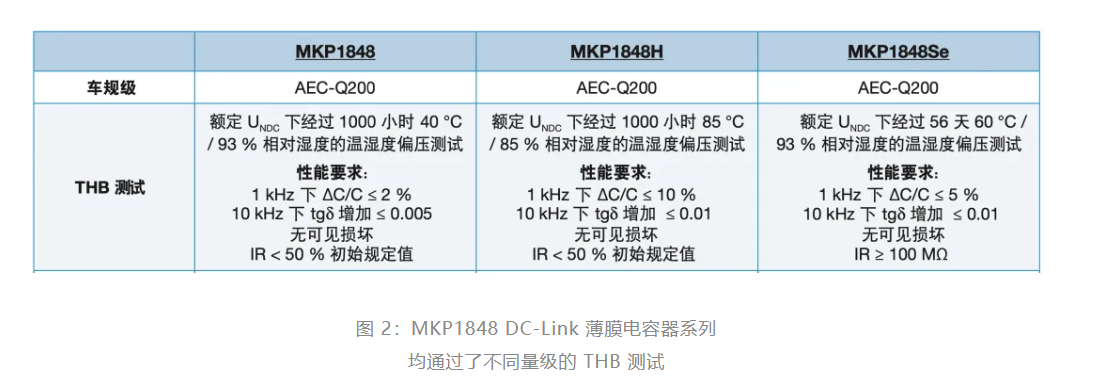
As a result, the resistance of DC-Link film capacitors to harsh environments has become a key factor to consider during product selection. It is also a critical focus for DC-Link capacitor manufacturers to achieve differentiation. For example, Vishay has introduced the automotive-grade thin DC-Link capacitor MKP1848Se for new energy vehicle applications. This capacitor not only meets the stringent AEC-Q200 automotive standard but also satisfies extremely rigorous Temperature-Humidity-Bias (THB) testing requirements. Under rated DC voltage, 60°C temperature, and 93% relative humidity conditions, it endures up to 56 days of THB testing, making it a standout product in its category.
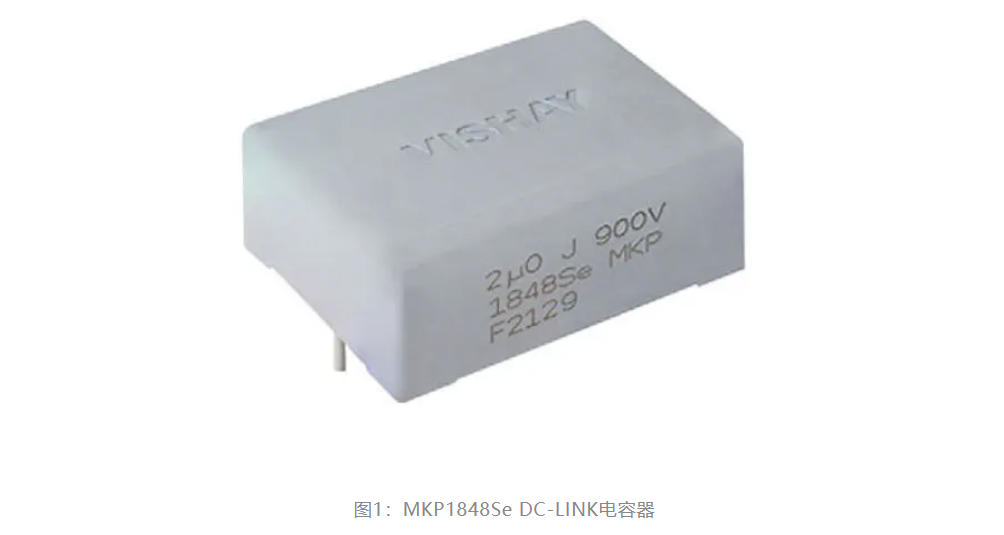
It is worth mentioning that the ability to withstand high-humidity and high-temperature environments has become a "signature" feature of Vishay's DC-Link film capacitors. The MKP1848 DC-Link film capacitor series has passed various levels of THB testing to meet the requirements of different environmental applications, providing strong support for the long-term stable operation of power systems.